Table of Contents
Report
Insect farming as a new way to produce fertilizer and human edible protein at home.

Author(s): Paul-Luchian Petrache, Benjamin Copinet, Marie Vandepitte, Finn Flügge, Leonie Margetich
Acknowledgement
Glossary
| Abbreviation | Description |
|---|---|
| EPS | European Project Semester |
| ISEP | Instituto Superior de Engenharia do Porto |
| USB | Universal Serial Bus |
| FMEA | Failure Mode & Effects Analysis |
| FAO | Food and Agriculture Organisation |
| Wi-Fi | Wireless Fidelity - Wireless internet |
| WBS | Work Breakdown Structure |
| RPN | Risk Priority Number |
| IPCC | Intergovernmental Panel on Climate Change |
| INSEE | Institut national de la statistique et des études économiques |
| GNP | Gross National Product |
| GDP | Gross Domestic Product |
| HTML | Hyper Text Markup Language |
| CSS | Cascading Style Sheets |
1. Introduction
European Project Semester (EPS) is a program in the first place for engineering students, but students of other fields of study are welcome as well. It is offered by universities all around Europe and is made to prepare engineering students to face the challenges of the contemporary economy.
The students work on a project with multinational and interdisciplinary teams. The semester lasts at least 15 weeks minimum. The students work together in English and get guided to focus on the product as well as the project [European Project Semester, 2022].
TeamOnesect - the company our team came up with, developed throughout the EPS the INFAKIT - a mealworm-farming kit to produce protein and fertilizer at home, a partly self-regulating setup with sensors and microcontrollers to control the ideal conditions. Moreover, we developed a small website, which allows the user to regulate and montior the INFAKIT from distance. Ethical, sustainable and modular aspects played a major role and guided as a red line throughout the process. This Report will summarize our approach, research and the strategies we came up with to plan, design and develope this product. A detailed description of the product can be found in chapter 7.
1.1 Presentation
We are Paul-Luchian, Benjamin, Marie, Finn, and Leonie (Figure 2). Five enthusiastic and motivated students from all around Europe and we are Team 1, TeamOnesect, from the EPS Project 2022 at Instituto Superior de Engenharia do Porto.
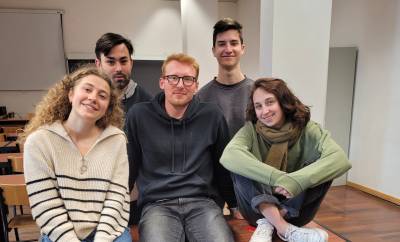
Under the guidance of a team of supervisors at ISEP, we will work on a multidisciplinary project with an ethical and sustainable purpose in mind. We will join our competencies and try to create a product that conforms to all European guidelines and regulations.
| Name | Country | Field of Study |
|---|---|---|
| Paul-Luchian Petrache | Romania | Engineering and Management of Smart Cities |
| Benjamin Copinet | France | Packaging Engineering |
| Marie Vandepitte | Belgium | Product Development |
| Finn Flügge | Germany | Production and Logistics |
| Leonie Margetich | Austria | Media Technology |
1.2 Motivation
When we look at our motivation to participate in the EPS program, we see that there are multiple reasons but the general idea is the same. We want to expand our knowledge by discovering multicultural ways of engineering and entrepreneurship. By studying abroad, you learn to work out of your comfort zone which improves your out-of-the-box thinking. Thereby, foreign studies enhance your English capacities.
1.3 Problem
In a world of overpopulation, pollution, global warming, and climate change is ecology and sustainability no longer absent from our society. Awareness about the changes that are happening is growing and more people want to make an effort.
The world's population is growing and all these extra mouths need to be fed. Although in Figure 3 you can see that the amount of meat that we have consumed the past 10 years has remained roughly constant, the emissions caused by food production are still way to high.

This is a big problem because the meat sector is on the top of the most polluters in the food industry and their environmental impact is huge, greenhouse gas emissions, agricultural land use and fresh water are increasing [Hannah Ritchie, Max Roser, 2017].
Meat consumption is also responsible for deforestation of wide areas of forests in South America. This causes a loss in carbon dioxide reduction and an increase in soil erosion. Especially the lack of sufficient carbon dioxide uptake is a big problem because the production of meat from animals, such as cattle or pigs, causes an increase in carbon dioxide and methane emissions[Sara De Vis, 2006]. Also by using the land to raise these animals, a lot of ecosystems are harmed and suffer from biodiversity loss [Ilija Djekic, 2015].
Although consuming fish emits six times less carbon emissions than consuming beef and five times less than consuming mutton, the consumption of fish still causes a lot of negative climate impacts [Emily Petsko, 2021]. Not only are water and sediment affected, but natural habitats are also affected. Abandoned nets cause major changes to the water and oceans, such as plastic pollution in our food chain and a decrease in sealife biodiversity, which have a huge impact on human and environmental health. This causes global climate changes [Colette Wabnitz, Wallace J Nichols, 2010].
Another major problem within Europe is the current soil degradation. Our soil is facing problems such as erosion, salinization, contamination, compaction, etc. The decrease of biodiversity and organic matter also affect the health of the soil. This is because our soils are constantly subjected to human activity and they are often not given time to recover. There is a need for sustainable soil management [Johan Ceenaeme, Filip De Naeyer, Victor Dries, Els Gommeren, Sofie Van den Bulck, Eddy Van Dyck, 2007].
The two problems above are closely related, in a report about The State of the World's Land and Water Resources for Food and Agriculture by the UN, they let it be known that soil degradation and water resource shortages are compromising global food production. According to them, the biggest threat is the loss in soil quality, followed by the loss of biodiversity and depletion of water resources [Food, Agriculture Organization of the United Nations, 2022].
1.4 Objectives
The above problems are just the tip of the iceberg of problems caused by meat/fish consumption and production. The usage of insects can help tackle these problems since it provides an alternative way to create human edible protein, without exploiting the world for soil and other resources as much as the norm food industry so far. We from TeamOnesect want to help with this. We want to make alternative forms of proteins easily and simply accessible to everyone. Furthermore, our goal is to eliminate the use of pesticides and other chemical soil improvers. With our product we want to create interest in eating insects and how their lifecycle looks like. We want to spread ecological awareness, and make something that is currently very strange and unusual the norm. The aim is to introduce consumers to the closed loop system. Also, when time and space is limited, we want to offer the option to be self-sufficient.
1.5 Requirements
For our product, we want to work with a closed loop system. The output of our product, the exuviae of the insects, stimulates plant growth. This forms the food for the insects in the form of organic food waste. In Figure 4 you can see a representation of our own closed cycle.
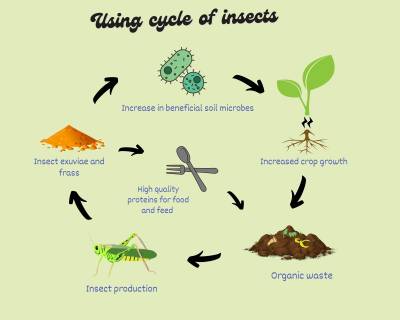
As output we create both an organic fertilizer and food for humans and/or animals. The exuvaie of the insects serve as organic fertilizer for plants. The fertilizer can be used in various situations, both indoors and outdoors. An absolute requirement is that the fertilizer does not contain additional chemical substances to guarantee the organic identity of the fertilizer. It should provide the plants with additional nutrition and have a positive effect on growth. Important is to mention that the insect waste should be composted before using it on plants. This is to prevent the plants from getting killed by an excessive amount of urea which is an organic compound to be found in insect waste.
The insects themselves will serve as nutrition at the end of our cycle. An accessible way to consume the insects as food must be considered. This can be dried, frozen, powdered etc. Therefore, the process from live insects to food must be done in an ethical and safe way. The food must be nutritious and useful to the body.
1.6 Functional Tests
The purpose of prototyping is to create a first version to verify the ease of use of the product. A prototype allows the concept to be validated, errors to be noticed and it shows the weaknesses of the design.
To validate our concept thoroughly and properly, we subject our prototype to some functional tests. These tests allow us to make (future) improvements and optimize the design. The following list will show an quick overview over tests we did and will further and more detailed be discussed in chapter 7.
- Test of technical setup (does setup work)
- Test of prototype design (materials used)
- Test of seperation with fan
- Test of freezing mealworms to death
- Test of perfect drying condititon for mealworms
- Test of mealworm-taste
To summarize our tests, we can say that we all ate self-breeded mealworms that we first froze and further baked and were surprised on how okay the worms actually tasted - like nothing in particular. Its important that the worms aren't starting to develope into the pupae state though, since that really has a disgusting taste and feel. Concerning the prototype we saw, that the setup works good to seperate the different states of mealworm development as well as seperating the frass and excuvae from the living animals via a fan and sieves - a stronger, more powerful fan would enable the seperation process in a faster and better way for the size of tray that we choose. The idea to control a dispenser with a servo motor could not be implemented - we can control it via the microcontroller, but the hardware implementation did not work as we thought.
1.7 Project Planning
To keep our project running smoothly we need clear and efficient project management. For the management we use Scrum. Scrum is an Agile form of Project Management. In this technique, the entire project period is divided into several intervals, called sprints.
Using a Backlog, each sprint is given a set of tasks with a certain priority value. These tasks must be completed by the end of the sprint. The Backlog allows team members to assign tasks to themselves and make this clear to the other members. Using a spreadsheet, an overview can be kept of which tasks have been completed, are being worked on, and which tasks are unassigned.
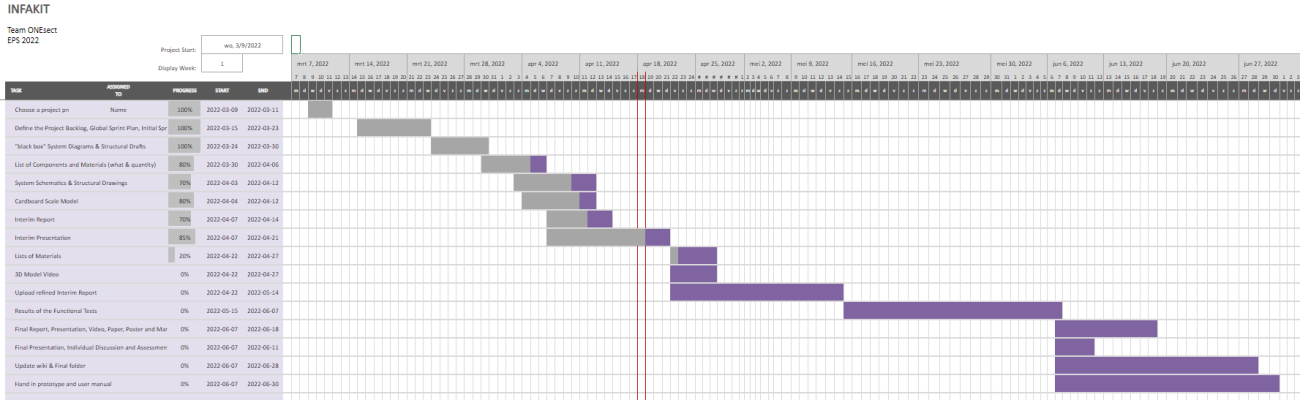
This sprint planning was created at the start of the project in the form of a Gantt Chart and was updated during the project after each sprint.
1.8 Report Structure
In this report, we begin with a thorough state of the art. We look at the current situation from both a commercial and scientific perspective. In the commercial part we look at the offers and the market around insect farming. Both products and services are taken into account. Emerging companies that want to delve into this are also included in this research. In the scientific part we look at what is possible around the raising of insects. The effects of eating and breeding insects are also looked at in a scientific way.
Next, the project management is stated. How we are going to spend our time, what techniques will be used to e.g., reduce risks, the organization of communication and how tasks will be divided are all part of the project management. The whole approach of the project will be discussed.
After this we move on to the marketing aspect of our product. Next to the branding aspect, a clear target group and strategy are chosen. The market is studied better and we take a clear position within this area. By means of a SWOT analysis, strengths and weaknesses along with opportunities and threats are compared. We submit our product to the marketing mix and see where we can improve. Budget management also falls under this heading.
Afterwards we look at the ecological aspects of our product. A list is made of the possible ecological impacts of our product and how we can improve our product in terms of sustainability. We also take into account the economic and social aspects and the costs that this may entail. Finally, this subsection looks at how the product can find a place in the circular economy.
Together with the ecological aspects, the ethical side of the story is also considered, both on a technical, ecological and social level. Is it responsible to put this product on the market? Does it comply with European regulations? Is the product reliable? Is there room for consumer confidence? These are just a few questions that are answered in this section.
Before the last chapter, we give a complete overview of the entire project. The final product is presented and also the road towards it. Both the initial brainstorming phase and the later structural design are shown here. Prototypes, test results and important design choices are shown here.
We finish with a conclusion of the project and possible future visions for our product.
| Task | Description |
|---|---|
| 1. Introduction | An introduction to our project and the road to it |
| 2. State of the Art | The current situation around our theme |
| 3. Project Management | How we handle the progress of the project |
| 4. Marketing Plan | The approach in the field of marketing and communication |
| 5. Eco-efficiency Measures for Sustainability | The ecological side of the project |
| 6. Ethical and Deontological Concerns | Ethical justification of the project |
| 7. Project Development | The process and evolutions of our project |
| 8. Conclusions | Final summary of the report and future visions |
| Bibliography | All sources used during the writing of this report |
2. State of the Art
2.1 Introduction
In the state of the art, the situation how it is now is shown. The question “What is currently going on in the world of insect farming?” is answered here. We divided it into a commercial and a scientific state of the art. Both research on the latest advances within the subject and short-term visions of the future are provided. The state of the art gives you a clear vision of the subject and what direction the project will take.
2.2 Commercial State of the Art
Before forming an idea for a possible concept, it is important to know what is already on the market when it comes to insect farming. During commercial research, we took a closer look at some bigger and smaller companies that are in the field of insect farming.
The first conclusion we made is that there are a lot of different possibilities. Insects are used for various purposes such as human diet, pet food, soil fertilizer, dye, etc. The goal of our project is to use insect farming as a new way to produce fertilizer and human edible protein at home. During our research, we focused more on that motive. Next to that, we also did some research on home-farming kits, to see what the possibilities are on that topic.
Big farms use sophisticated insect technologies to farm a large scale of insects and sell them, or their frass and exuviae, for commercial use. Most of these companies use technology-driven, sustainable, circular, and innovative techniques such as special storage systems, industrial washing machines, control software, and smart measuring tools [Viscon Group, 2022]. Because these companies are targeting larger production and target groups, they have done a lot of scientific research on the benefits (and disadvantages) of their projects and products. The main target product of these businesses is pet foods and soil fertilizer.
Further is there also a niche where the output isn’t a product made out of insects, but these companies offer insect farming technologies. They deliver services, machines, technologies, and other facilities to improve the insect farming sector [Protenga, 2022].
The company Livin Farms offers a farming service, by using industrial food waste to make protein powder, lipids, and fertilizer. They created a modular construction system for fully automated insect factories for rearing insects on a high scale. By using Plug&Play technology they provide other businesses with the process to produce insect protein. (Plug&Play technologies are devices that work with a computer system as soon as they are connected. The consuming company doesn't need any other drivers, setup or knowledge.) The customer gets a bi-weekly delivery of seedlings for the production of the insects. Through a 7 days cycle, the customer rears the insects (black soldier fly larvae) on-site to create the desired product for sale [Livin Farms, 2022].
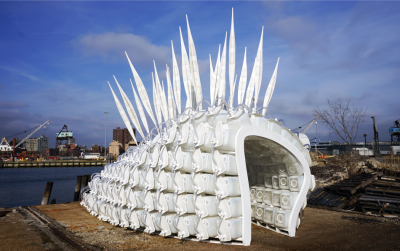
The association Terreform ONE developed a Cricket Shelter as you can see in Figure 5 [Terreform ONE, 2022]. The Cricket Shelter is in the form of an array of structural pods that promote the optimal vicinity for crickets. Terreform ONE is a nonprofit art, architecture, and design research group that fight the extinction of planetary species by creating and designing inclusive spaces and systems that aim for global environmental justice. Their focus is based on ecological planning, biotech architecture, urban systems, and public art. By creating the Cricket Shelter, Terreform ONE wants to educate the general public about its role in sustainable consumption. The installation consists of a series of modular containers that could be customized as needed with ventilation, flexible cricket sacks, and permeable feeder ports. On top of the installation are 25 quills attached to vent the cricket farm naturally and to amplify the stridulation sound while reproducing.
We see that the amount of businesses that supply insect farming at home is remarkably smaller than the businesses that do insect farming on a larger scale. These home farming installations have different types of uses. For example, the company Livin Farms, Figure 6, created The Hive Explorer , the first desktop hive to farm insects, both for personal and educational use. By using their device, you can recycle your food waste from home into alternative proteins and organic fertilizer through the work of mealworms [The Hive Explorer, 2022].
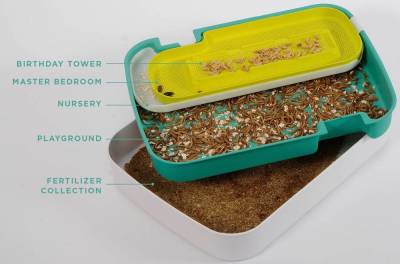
In Figure 7 you can see the device the company BeoBia designed [BeoBia, 2022]. BeoBia provides a product that is very simular to The Hove Explorer. They designed eco–growing pods and present themselves as the future of pet food. They developed a closed-loop system that turns food waste into mealworm protein and plant fertilizer. The output is pet food ideal for birds, fish, reptiles, and amphibians.
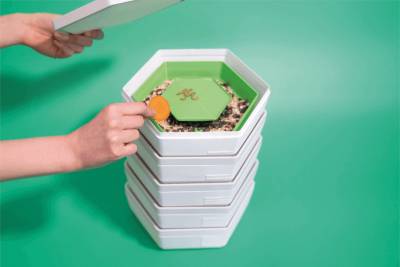
The offer for devices like this is quite limited. This means that there are still a lot of options for us to come up with an innovative and useful product. There is a lot of potential for more refined monitoring and more user-friendliness. In Table 4 you can find an overview of all the companies we did research on.
| Company Name | Idea Discription | Products | Insects | Link |
|---|---|---|---|---|
| Livin Farms | Insect powered technology forcircular economies: turning industrial food waste into valuable end products (fertilizers, protein, animal feed…) | Hive Explorer set – educational use; Plug&Pay Service; Hive Pro | Mealworms; Black Soldier Fly Larve | [Livin Farms, 2022] |
| Protenga | Innovation – especially in nutrition and sustainability and re-thinking insect farming through our technology-driven circular ecosystem approach | Insects for Aquaculture; Insects for Pets; Insects for Poultry; Insects for Crops | Black Soldier Fly | [Protenga, 2022] |
| Viscongroup | Developing the logistical process with our customers | Insect farming technologies | Black Soldier Fly; Mealworms; Cricket; Maggots | [Viscon Group, 2022] |
| Aspire Food Group | Building autonomous robotics, centralized distribution systems and custom assemblies to farm our insects from hatch-to-harvest | Insect farming technologies for human food, pet food and fertilizer | Weevil; Cricket | [Aspire, 2022] |
| BeoBia | Breeding mealworms to produce pet feed and fertilizer | Growing pods to harvest pet food at home | Mealworms | [BeoBia, 2022] |
| Open Tiny Farms | A simple at-home mealworm farm which released open source with the launch of Open Bug Farm project | Open-source mealworm kit; Cricket farming technology | Mealworms;Crickets | [Opentinyfarm, 2022] |
| Insect Feed Technologies | Take food waste and transform it into sustainable, all-natural protein and oil for pet food, aquafeed, and nutrient-rich organic fertilizers for agriculture | Black Soldier Fly Dried Larvae – Pet Food; Black Soldier Fly Insect Meal (Milled Larvae) - Pet Food; Black Soldier Fly Organic Fertilizer (Frass) | Black Soldier Fly | [Insect feed technologies, 2022] |
| Terreform ONE | Design against extinction | Cricket Shelter | Crickets | [Terreform ONE, 2022] |
From this state of the art, we can conclude that the insect farming market is bigger than originally expected. We can use the refined research from the big companies to see what the benefits and disadvantages are from certain insects and methods. The smaller companies and devices can give us inspiration about what are the possibilities and what’s already done. The main goal now is to use the right information and make a useful and innovative product.
2.3 Scientific State of the Art
With the choice of the project, there were some questions upcoming regarding for example regulations and general information about insects. First, is insect farming actually better for the environment and still can provide all the required nutrition? Is it allowed to just breed any insects you want for food production? And what insects provide the best protein stats compared to their needed living conditions and the complexity of the habitat in which they live?
Compared to normal livestock farming insect farming has many advantages. Insects at every life stage function as a rich source of animal protein. “Edible insects usually contain more crude protein compared with conventional meat […]. As food, they can provide essential amino acids at an ideal level, which are generally 76 % - 96 % digestible.” [Chufei Tang, Ding Yang, Huaijian Liao, Hongwu Sun, Chuanjing Liu, Lanjun Wei, Fanfan Li, 2019] But not only the level of proteins, but also the amounts of fat, vitamins, and minerals are comparable to those of meat [Antonella Baiano, 2020].
But insects cannot only compete with livestock on a nutritional basis. As there are already more than one million insects described and 4 - 30 million species of insects estimated on earth, they find an ecological niche everywhere, places that are overtaken by humans, but also those which are mostly untouched. “With this diversity and their collective adaptability, they are a much safer source for future food security than are vertebrate animals such as cattle, fowl, or even fish. Since there are insects of some sort on nearly every patch of land on earth, chances are that some local species in every area can be farmed as human food without the need to import nonnative species for the same purpose” [Ruparao Gahukar, 2016].
Furthermore, insects also “win” comparing the environmental aspects. Lars-Henrik Lau Heckmann, a Biologist and Ph.D. from The Danish Technological Institute and also an expert in insect farming says that he usually assumes that rearing insects is 100 times more environmentally friendly than raising cattle [Kristian Sjøgren, 2017]. The United Nations’ Food and Agriculture Organization (FAO) states that insects not only emit fewer greenhouse gases and produce less ammonia than cattle and pigs, but also require significantly less land and water than cattle and have a much higher feed conversion ratio than cattle, pigs and chicken [Arnold Van Huis, Dennis GAB Oonincx, 2017].
As we already established in our problem description the ongoing anthropogenic-induced climate change [Krishna Ramanujan, 2022], the growing world population[UN, 2022], and the shortage of water [Matti Kummu, Joseph Guillaume, Hans Moel, Stephanie Eisner, Martina Flörke, Miina Porkka, Stefan Siebert, Ted I.E. Veldkamp, Philip Ward, 2016] and land are some of the key challenges we face in close future, which are all attacked by insect farming.
Besides the more positive effect on the environment, even insect waste can be reused. Debris are made up of frass, basically a mix of the excretions and unconsumed food, and exuviae, the exoskeletons left behind after molting. This waste can be used as a highly effective fertilizer as frass and exuviae have “[…] a great impact on soil fertility due to high nutrient and labile C content” [David Houben, Guillaume Daoulas, Michel-Pierre Faucon, Anne-Maïmiti Dulaurent, 2020].
So overall it can be said that insects not only provide the same or even better amounts of nutrition but also are a much safer source of food, which has also fewer negative effects on the environment and even provide a byproduct, which can be used as a highly efficient fertilizer.
As there are many food regulations, we researched what insects are authorized to be farmed and eaten. According to the EU-commissions food regulations, there are only five different insects that are approved. These insects are [European Commission, 2015]:
- Whole and ground Alphitobius diaperinus (lesser mealworm) larvae products
- Whole and ground crickets (Acheta domesticus)
- Whole and ground grasshopper (Locusta migratoria)
- Whole and ground mealworm (Tenebrio Molitor) larvae
- Dried Gryllodes sigillatus
After we “narrowed down” the possible insects due to the regulations, we started comparing these insects regarding their life expectancy, the diet which needs to be provided, the general living conditions, how difficult it is to breed and farm them, and also how much frass and exuviae they produce. Shortly after the first research, it became clearer and clearer that Tenebrio Molitor, the yellow mealworm, would be the best choice to go with. Not only it is one of the most economical species to produce protein-rich food, as their dried matter contains around 50 % proteins, also during the metamorphosis of larvae into yellow mealworm pupa, up to 6 exuviae can be generated [Foss, 2019].
In addition, other than the Acheta Domesticus, Gryllodes Sigillatus and Locusta Migratoria, Mealworms are very slow, as they do not fly, jump, or run at all and move very slowly. Furthermore, the Tenebrio Molitor is extremely easy to care for, neither do they need any light nor any water to be added, as they are very efficient at extracting water from the food. Their diet is based on dry cornmeal, rolled oats, breakfast flakes, or similar dry food matter, sometimes some kind of vegetable, potato, or fruit needs to be added to assure their water supply. In addition, they can withstand temperatures from 4 °C - 35 °C and humidity from 50 % - 75 %, but if you want your population to grow faster and have a more stable lifecycle the ideal temperature is around 25 °C - 27 °C and the humidity from 65 % - 70 % [ExoticNutrition, 2021].
Speaking about the mealworm lifecycle it can be divided in four different stages. As it is a cycle it has no real beginning so we will start with the stage of the mealworm cycle, when they are the youngest.
Therefore the first stage of the cycle are the eggs, which are around 1mm in diameter. It is normal for them to hatch after around ten to twelve days and become larva afterward. These larvas grow for about three to four month until they reach a size of about two to three centimeters in length and three millimeter in diameter. Once they are evolved enough they pupate in which stadium they will be without food or water for around 12-20 days. If the end of this stage arrived they leave there pupae and become first white and after some days black beetles. These beetles are able to produce and lay eggs themselves after around one to three month. Now the whole life cycle is closed and if fed and kept properly it is an never outrunning source of protein.
If you add up all the possible time it will take, a whole cycle can be closed in shortest 140 and longest 240 days, which you can also see in Figure 8

2.4 State of the art of legislation and regulation in insect breeding
As almost everything also the insect food market is regulated by the laws of the European Union. Therefore, we must make sure that our idea, how we imagine the product we want to provide, is actually legal in the EU. The EU itself differs into two different forms of “insect-farming” on one hand the commercial one, done by companies for commercial purposes, which are promoted and sold as food, and on the other hand non-commercial farming you do at home for yourself or for other non-commercial reasons. The second kind of insect farming, and the one we want to promote, was never illegal. You can farm these insects and do with them whatever you want if they are not sold or promoted as food in any other way. As we want to provide our customers with mealworms, not necessarily to eat as they decide what they want to do with them, we wanted to make sure that even the commercial selling for eating is allowed in the EU. Luckily, we found out that the mealworms were the first insect added to the Novel Food Regulation List of the EU in May 2021 [European Comission, 2021], which states these animals, that are approved for not only selling these insects as a whole food but also to work for example with mealworm-flour in their products, such as pasta or bread. After adding the mealworms to that list the list extended and more and more insects, such as crickets, are approved for commercial uses nowadays, which also shows a change not only in the minds but also in the actual European law.
2.5 Conclusion
The study of the various insects and also of companies offering services similar to those we have envisaged allows us to see more clearly.
From a commercial point of view, it reinforces the idea that there is a market and that it will be possible to evolve as a new company. It also informs us that we will have to differentiate ourselves from our competitors and seriously invest in the communication of our product as well as in the identity of our company.
On the scientific side of our project, a better understanding of the living conditions and properties of different insects will help us to make a decision. In order to make this decision, the most important aspects were examined. These include compliance with the law and the market, the protein content of the chosen insect, the ability of the species to moult, the ease of rearing and the resistance of the species to the changing conditions in the home. For this purpose, the species Tenebrio Molitor seemed to us quite adapted. Thus, we will always refer to this species when we talk about insects in a broad sense.
The following chapter explains the approach we have decided to take to the management of our project.
3. Project Management
3.1 Scope
The scope of a project sets a frame of the work, necessary to do in order to deliver a proper project outcome. In our case, the scope is defined in a work breakdown structure (WBS), which can be found in Figure 9. The WBS is a tool for analyzing and structuring different components of a project for easier and more efficient project management. Ongoing with the project components, and sub-components can be added, as it is not fixed and it gives a global overview of the project and the work done or needed to be done to achieve an appropriate outcome. For that reason and in order to minimize the risk of failure, the WBS is commonly used in many projects and represents a very helpful tool for project management.

3.2 Time
For the time management component, there are many different things to consider. EPS consists not only of the project and its associated deadlines, Table 5, but also of a series of courses.
Courses that are part of the EPS project at ISEP:
- Energy & Sustainable Development
- Ethics & Deontology in Engineering
- Marketing & Communication
- Portuguese
- Project Management & Teamwork
Table 5 shows all the deadlines that must be handed in for the project.
| Date | Deadline |
|---|---|
| 2022-03-06 | Project Proposal |
| 2022-03-16 | Project Backlog, Global Sprint Plan, Initial Sprint Plan and Release Gantt Chart of the project |
| 2022-03-23 | The “black box” System Diagrams & Structural Drafts |
| 2022-04-06 | The List of Components and Materials |
| 2022-04-12 | The detailed System Schematics & Structural Drawings and the cardboard scale model of the structure |
| 2022-04-14 | Upload the Interim Report and Presentation |
| 2022-04-21 | Interim Presentation, Discussion and Peer, Teacher and Supervisor Feedbacks |
| 2022-04-27 | The final List of Materials (local providers & price, including VAT and transportation) and the 3D Model Video |
| 2022-05-14 | Refined Interim Report (based on Teacher & Supervisor Feedback) |
| 2022-06-07 | The results of the Functional Tests |
| 2022-06-18 | The Final Report, Presentation, Video, Paper, Poster and Manual |
| 2022-06-23 | Final Presentation, Individual Discussion and Assessment |
| 2022-06-28 | The refined deliverables (source + PDF) together with all code and drawings produced |
| 2022-06-30 | The prototype and user manual |
To meet these deadlines in conjunction with attending classes, we use an agile method of time management. Scrum allows us to adjust our time schedule according to the current situation. Using sprints, we are able to distinguish the highest priority items from the less urgent goals. In Figure 10 you can see our Gantt Chart to keep an overview of our project and the process towards it.
3.3 Cost
The practice of planning and controlling the costs associated with running a business is known as cost management. It involves gathering, evaluating, and reporting cost information in order to better budget, forecast, and monitor expenses. In most cases, cost management focuses on generating savings and profit maximization [Gartner, 2021]. As a team, we have decided that in the beginning our salaries will be below the average salary of an engineer in Portugal because we would rather have more money to re-invest for developing the best possible product.
For establishing the cost estimation, we've considered labor costs, marketing and product development costs.
| Cost type | Amount | Total per year |
|---|---|---|
| Salaries | 5 x 800€/month | 48 000€ |
| Marketing | 1 408,3€/month | 16 900€ |
| Product cost | 64.29€/product | - |
| Total | 5408€ + product cost | 64 900€ + product cost |
3.4 Quality
In the quality component, we look at the quality of both the product and the project. Although we do not want to present ourselves on the market as a high standard product, we do want to be able to give consumers a guarantee of quality. That is why we look at quality across the board and why we subdivide the quality management component into product quality, service quality and teamwork quality.
3.4.1 Product quality
With our product, we want to come to the market with a quality product that meets as many user expectations as possible. When people purchase the INFAKIT, they are not only taking a product into their home, but also the responsibility of maintaining the mealworms. So, the product should definitely not disappoint after purchase.
We divide the product quality into 4 parts: functionality, components, materials and assembly.
Functionality: The product must do what it promises. The functions of the INFAKIT are clearly communicated to the consumer in advance. It is also important that all functionalities are easily and clearly accessible. Color indications and visual markings indicate the different functions. Redundant functions or elements are avoided to prevent confusion.
Components: To ensure the quality of the different (electrical) components, a list of components is prepared. In this list all the different properties of the components are compared. Based on these properties, the component that best fits within the framework of our product is chosen.
Materials: To choose our materials, we also base them on the list of components. From that list, we choose the components with the materials that appeal to us the most. We keep several pillars in mind, e.g. safety, durability, price, etc.
Assembly: For the assembly we ensure the simplest possible set-up. Redundant parts are omitted and difficult operations in different directions are avoided. This is not only more efficient but also cheaper. For the setup of the product at the consumer we provide a quality user manual. We ensure that the parts slide smoothly into each other and provide protrusions to prevent an incorrect set-up.
3.4.2 Service quality
In addition to product quality, we naturally want to provide good service to our customers. Therefore, the product INFAKIT will not only consist of the physical parts, but there will also be a helpline available. With this helpline people can ask questions or give advice about their mealworms or the INFAKIT. When a question is asked, we strive for an answer within 24 hours.
Furthermore, we want, in time, next to a helpline service also create a community. Through a forum connected to INFAKIT, users can share experiences and answer each other's questions under the supervision of experts. Also, communication via various social media ensures a permanent involvement with the product and our service.
Even in the case of broken components, the modular design makes it easy to buy new replacement parts. Instruction manuals and videos make it possible for the users to repair the product themself.
3.4.3 Teamwork quality
To achieve the above quality levels, of course, good teamwork quality is needed. The key to achieve this is communication. By keeping each other informed on a timely and regular basis of progress everyone is working on, we try to get a clear overview of the current situation of the project. Clear communication goes hand in hand with a clear division of tasks. Using a clear schedule, tasks are assigned to different people and people can also assign themselves a task.
3.5 People
In order for the management of a project to run smoothly, tasks must be divided. It is important to be clear about who is doing what. Inefficient situations and duplication of work can thus be avoided.
It is important to give team members an appropriate task that matches their abilities and interests. Of course, less straightforward tasks also need to be carried out. For these tasks, team members can work together and thus combine their strengths.
Table 7 shows a task distribution of who performed which tasks.
| Task | Person |
|---|---|
| Introduction | Finn, Marie |
| Commercial State of the Art | Leonie, Marie |
| Scientific State of the Art | Finn, Benjamin, Paul-Luchian |
| Project Management | Finn, Marie |
| Marketing Plan | Benjamin |
| Eco-efficiency Measures for Sustainability | Leonie |
| Ethical and Deontological Concerns | Paul-Luchian |
| Project Development | Team |
| Conclusions | Team |
| Project Proposal | Team |
| Backlog | Leonie, Marie |
| Global Sprint Plan | Leonie, Marie |
| Gantt Chart | Leonie, Marie |
| “Black Box” System Diagrams | Finn, Benjamin |
| Structural Drafts | Leonie |
| List of Components and Materials | Leonie |
| System Schematics | Leonie, Paul-Luchian |
| Structural Drawing | Marie |
| Cardboard Scale Model | Finn, Paul-Luchian, Marie |
| Interim Report Presentation | Benjamin |
| 3D Model Video | Marie |
| Project Video | Benjamin |
| Functional Tests | Leonie |
| Code | Paul-Luchian |
| Prototype | Leonie |
| User Manual | Finn |
In any case, everything is gone over by the entire team and every decision is clearly briefed with the whole team. This way we ensure that everyone is aware of the content of the report and the state of the project. By informing each other regularly about new progress, we can also work further and in more detail on earlier and further tasks.
3.6 Communications
Clear agreements must be made in order to have good communication within the team and to the outside world. Communication is one of the key elements to make a project run smoothly. It is extremely important to regularly inform each other about the status of the project at that moment. Table 8 shows the main Communication Management during our project.
| Communication | Goal | Medium | Moment | People |
|---|---|---|---|---|
| Brainstorming and Ideation | Coming up with ideas and solutions | Physical, Miro | First step in the process of any development | Team |
| Deliverables | Project Development | Physical, WhatsApp, Teams | The week(s) before the deliverable | Team |
| Planning | Hand in deliverables on time | Planner, Teams, WhatsApp | Task assignment | Team |
| Project Updates | Inform the team of further progress | WhatsApp, Teams | Every update | Team |
| Team Meetings | Devide task, plan, update | Physical | Multiple times per week | Team |
| Project Meeting | Inform the supervisors of the current situation | Physical, Teams, Mail | Weekly | Supervisors + Team |
Also, not only should communication within the team be smooth and on a regular basis, but communication with the various stakeholders is important.
3.7 Risk
Risk Management is used to identify risks and evaluate and prioritize them. This allows us to minimize, monitor, and control the impact of these events. Assessing risks involves risk identification, risk evaluation, risk handling and risk controlling.
We used Failure Mode & Effects Analysis, FMEA, to analyze the potential risks of our product. FMEA is a step-by-step approach for pointing out all the possible failures in any process, whether it is a design, manufacturing, or assembly process. The technique is used to eliminate or reduce all the failures, starting with the ones with the highest priority [ISIXSIGMA, 2022].
Table 9 is a visualization of the risk our product may be exposed.
| Process Step | Potential Failure Mode | Potential Failure Effects | SEVERITY (1-10) | Potential Causes | OCCURRENCE (1-10) | Method of detection | DETECTION (1-10) | RPN SCORE (SxOxD) | Actions to reduce RPN |
|---|---|---|---|---|---|---|---|---|---|
| Installing the device | Wrong installation | Insects escape, wrong monitoring, injuries, fire | 7 | Assemble the components wrong | 6 | Escaping insects; unlikely monitoring results | 5 | 210 | Visual differences when put in wrong together; Clear user manual |
| Installing the device | Component is missing | Installation impossible / error | 9 | Packaging error | 2 | Counting the components | 2 | 36 | List of components; clear user manual |
| Monitoring the insects | Disrupted humidity / temperature | Mold / smell | 10 | Sensors (connections) don’t work optimal | 3 | Smell, color differences, lots of dead insects | 6 | 180 | Advice a regular checkup, app remarks unusuality's |
| Feeding the insects | Put in indigestible foods for insects | Insects die | 7 | Human error | 6 | Food doesn’t get eaten, dead insects | 5 | 210 | Clear communication about insect diet |
| Removing frass | Unbalance on the frass component | Frass falls on the ground | 5 | Human error | 3 | Spilled frass | 2 | 30 | Decent handle; Distribute weight evenly |
| Freezing the mealworms | |||||||||
| Blending the mealworms | |||||||||
| Cleaning the device | Incorrect cleaning of the product, separate parts who are not meant to separate | Damaged parts | 9 | Using wrong products, not reading the manual | 6 | Product is not working optimal | 8 | 432 | Clear user manual |
| Cleaning the device | Cleaning electrical parts with water | Broken parts, shock | 9 | Human error | 5 | System not working | 2 | 90 | Clear user manual, warning signs |
- Severity: Severity of impact of failure event. It is scored on a scale of 1 to 10. A high score is assigned to high-impact events while a low score is assigned to low-impact events.
- Occurrence: Frequency of occurrence of failure event. It is scored on a scale of 1 to 10. A high score is assigned to frequently occurring events while events with low occurrence are assigned a low score.
- Detection: Ability of process control to detect the occurrence of failure events. It is scored on a scale of 1 to 10. A failure event that can be easily detected by the process control is assigned a low score while a high score is assigned to an inconspicuous event.
- Risk Priority Number: The overall risk score of an event it is calculated by multiplying the scores for severity, occurrence and detection. An event with a high RPN demands immediate attention while events with lover RPNs are less risky.
Now that we have created an FMEA table, it is important to address the risks with the highest RPN scores. Most dangerous thing for mealworm is moisture and dampness, which create mold and smell. The biggest risks are improper installation and cleaning, disrupted sensors, and feeding the wrong food.
These problems can be easily reduced in the first instance by providing a clear manual with the product. Moreover, this can also reduce other, less crucial risks. The manual should not only be clear, it should also be concise without losing important info. Good, fast readability is the most important feature of a user manual.
3.8 Procurement
For the procurement of the parts of our product, we strive for sustainable and local parts without losing sight of our budget. The project has a limited budget of 100 euros. This means that the price will probably be one of the main reasons why a component will or will not be purchased. Of course, quality should not be compromised under this condition.
Buying within Portugal, preferably Porto, is another criterion. The purchase of local products not only promotes the local economy, often the ecological impact is smaller and the shipping / transport costs are also much lower than an international purchase of goods. Naturally, not only the delivery cost is important, the delivery time is also a reason. The project runs over a fairly short time span, delivery at relatively short notice is essential.
Finally, our product has a life cycle and we want to create an ecological product. Recycled parts and ecologically sound raw materials have a positive influence on the choice of whether or not to buy a product. The production method is also important. We not only want to deliver an ecological product but also an ethical one.
Finally, of course, we want to deliver a safe and responsible product. When using the product, it is important that the user is not exposed to hazardous substances. The purchase of safe components is therefore certainly also a pillar in whether or not to purchase raw materials.
In short:
- Price
- Quality
- Local
- Delivery time
- Sustainable and ethical background
- Safety
3.9 Stakeholders Management
In the following chapter, we are going to identify our key stakeholders, the influence and the interest they have in our project, and how to handle the different groups of Stakeholders. To identify the Stakeholders first needs to be defined what a Stakeholder is: Stakeholders are individuals, groups of people, organizations, or governmental departments, who are on one hand impacted by the outcome of the project, but also, on the other hand, have an influence, either positive or negative, on the project. They have usually a big interest in the success of the project and can be divided into internal (included in the project) and external Stakeholders.
For our project, we came up with 10 different groups of Stakeholders you must keep in mind to manage them properly. This group can be divided into two smaller groups, one group of stakeholders regarding the EPS project and one group of stakeholders for our actual company. Figure 8 makes clear which group each group of Stakeholder belongs to. We decided not only to take these stakeholders into consideration, which are important right now, e.g. as the “group of supervisors”, but also those which may be more important when we carry out our outcome, for example, the environmental associations. The managing divides into 4 different “levels” of managing:
- Monitor
- Keep informed
- Keep satisfied
- Manage closely
To allocate the Stakeholders to one of these levels, their “extent of interest” and “degree of influence” need to be defined, this is what you see in Figure 11:

To explain our way of managing a little closer we will now inform about one Stakeholder from each field and possible ways to manage them.
One of the biggest and most influential groups of Stakeholders for our project and future company will be of course our customers. They have quite a high interest in the final product and a big influence on the design and execution. Therefore, we decided to manage them closely, which can be done for example by carrying out surveys to our customers, having our customer service keep track of complaints and suggestions, or even by analyzing our sales numbers.
A group of Stakeholders which we need to keep informed are for example our suppliers. They need information about changes in our products, in our requested amounts and in general about our business situation. We plan to do that by regularly repeating meetings, close contact between our procurement and the suppliers, and a newsletter about changes.
Governmental departments or environmental associations for us need to be satisfied by our work and how we carry it out. In this case, the management needs to be adapted more individually to the two groups of stakeholders. The government is already satisfied if we stick to the governmental regulations and laws, pay our takes accordingly and create new workspaces. The environmental associations need to be satisfied by our standards for the insects and would appreciate an environmentally friendly design.
The last field of managing our Stakeholders is monitoring, which for example needs to be done with our competitors. This can be done by just normal research, for example on the internet or on special occasions like trade fairs or in specific literature like magazines. Furthermore, the exchange of know-how in form of a joint venture or a collaboration can also be a good way to monitor your competitors.
In Figure 12 you will find all our already mentioned and the unmentioned Stakeholders, allocated to the according field of management.


3.10 Sprint Outcomes
At the beginning of the project, a backlog was created to have a clear overview of the tasks to be performed. As mentioned earlier in Chapter 3.2, we also created a Gantt Chart based on this backlog (see Table 5). This helps us to keep an overview of where we are in the project and how far we are with the tasks to be executed.
To smoothly complete all the tasks in this backlog, we started by creating a sprint plan. Each sprint contained two weeks. Table 10 shows the original dates of the sprints.
| Sprint | Start | Finish |
|---|---|---|
| 0 | 10/03/2022 | 23/03/2022 |
| 1 | 24/03/2022 | 07/04/2022 |
| 2 | 08/04/2022 | 20/04/2022 |
| 3 | 21/04/2022 | 04/05/2022 |
| 4 | 05/05/2022 | 18/05/2022 |
| 5 | 19/05/2022 | 01/06/2022 |
| 6 | 02/06/2022 | 15/06/2022 |
| 7 | 16/06/2022 | 29/06/2022 |
At the beginning of sprint five, when the project was coming a bit more to an end, we noticed that the tasks were starting to pile up. There were more tasks to complete and also previously completed tasks needed to be reviewed and finalized. We concluded that 2-week sprints were too long. A new sprint planning of sprints with only one week was established in Table 11.
| Sprint | Start | Finish |
|---|---|---|
| 0 | 10/03/2022 | 23/03/2022 |
| 1 | 24/03/2022 | 07/04/2022 |
| 2 | 08/04/2022 | 20/04/2022 |
| 3 | 21/04/2022 | 04/05/2022 |
| 4 | 05/05/2022 | 18/05/2022 |
| 5 | 19/05/2022 | 25/05/2022 |
| 6 | 26/05/2022 | 01/06/2022 |
| 7 | 02/06/2022 | 08/06/2022 |
| 8 | 09/06/2022 | 15/06/2022 |
| 9 | 16/06/2022 | 22/06/2022 |
| 10 | 23/06/2022 | 29/06/2022 |
To this sprint planning, tasks to be performed were then added in a Table 12. Individuals were then made responsible for these tasks. The current status of the task can also be found in the table (Unassigned, WIP (Work In Progress), Done).
| Deliverable | Task | Responsible | Status |
|---|---|---|---|
| Sprint 0: 10/03/2022 - 23/03/2022 | |||
| Project | Project Proposal | Everyone | Done |
| Report | Project Backlog, Global Sprint Plan, Initial Sprint Plan and Release Gantt Chart of the project | Marie, Leonie | Done |
| Deliverable | The “black box” System Diagrams & Structural Drafts | Finn | Done |
| Report | State of the art - Scientific | Benjamin, Finn, Paul | Done |
| Report | State of the art - Commercial | Marie, Leonie | Done |
| Sprint 1: 24/03/2022 - 07/04/2022 | |||
| Deliverable | The List of Components and Materials | Leonie, Paul-Luchian | Done |
| Sprint 2: 08/04/2022 - 20/04/2022 | |||
| Report | The detailed System Schematics & Structural Drawings and the cardboard scale model of the structure | Leonie, Marie | Done |
| Presentation | Interim Presentation | Benjamin | Done |
| Interim Report | Introduction | Finn, Marie | Done |
| Interim Report | Commercial State of the Art | Leonie, Marie | Done |
| Interim Report | Scientific State of the Art | Benjamin, Finn, Paul-Luchian | Done |
| Interim Report | Project Management | Finn, Marie | Done |
| Interim Report | Marketing Plan | Benjamin | Done |
| Interim Report | Eco-efficiency Measures for Sustainability | Leonie | Done |
| Interim Report | Ethical and Deontological Concerns | Paul-Luchian | Done |
| Interim Report | Project Development | Everyone | Done |
| Sprint 3: 21/04/2022 - 04/05/2022 | |||
| Deliverable | Final The List of Components and Materials | Leonie, Paul-Luchian | Done |
| Deliverable | 3D Model Video | Marie | Done |
| Sprint 4: 05/05/2022 - 18/05/2022 | |||
| Refined Interim Report | Introduction | Finn, Marie | Done |
| Refined Interim Report | Commercial State of the Art | Leonie, Marie | Done |
| Refined Interim Report | Scientific State of the Art | Benjamin, Finn, Paul-Luchian | Done |
| Refined Interim Report | Project Management | Finn, Marie | Done |
| Refined Interim Report | Marketing Plan | Benjamin | Done |
| Refined Interim Report | Eco-efficiency Measures for Sustainability | Leonie | Done |
| Refined Interim Report | Ethical and Deontological Concerns | Paul-Luchian | Done |
| Refined Interim Report | Project Development | Everyone | Done |
| Refined Interim Report | Conclusions | Finn, Benjamin, Marie | Done |
| Sprint 5: 19/05/2022 - 25/05/2022 | |||
| Paper | Abstract | Finn | Done |
| Paper | Introduction | Marie | Done |
| Paper | Preliminary Studies: Related Work | Marie | Done |
| Paper | Preliminary Studies: Ethics | Paul-Luchian | Done |
| Paper | Preliminary Studies: Marketing | Benjamin | Done |
| Paper | Preliminary Studies: Sustainability | Leonie | Done |
| Paper | Proposed Solution: Concept | Finn | Done |
| Paper | Proposed Solution: Design | Finn | Done |
| Paper | Prototype Development: Assembly | Leonie | Done |
| Paper | Prototype Development: Tests & Results | Leonie | Done |
| Paper | Prototype Development: Discussion | Finn | Done |
| Paper | Conclusion | Finn | Done |
| Sprint 6: 26/05/2022 - 01/06/2022 | |||
| Deliverable | Packaging Solution | Benjamin | Done |
| Sprint 7: 02/06/2022 - 08/06/2022 | |||
| Report | Functional Tests | Leonie | Done |
| Prototype | Nontechnical Setup | Leonie | Done |
| Prototype | Code Website | Paul-Luchian | Done |
| Prototype | Webconnection | Paul-Luchian | Done |
| Prototype | Control View | Paul-Luchian | Done |
| Sprint 8: 09/06/2022 - 15/06/2022 | |||
| Prototype | Refining Prototype | Leonie, Paul-Luchian | Done |
| Report | Refining Report | Everyone | Done |
| Paper | Refining Scientific Paper | Everyone | Done |
| Video | Refining Product Video | Marie | Done |
| Poster | Refining Product Poster | Benjamin | Done |
| Poster | Refining Scientific Poster | Benjamin | Done |
| Manual | Refining Product Manual | Finn | Done |
| Sprint 9: 16/06/2022 - 22/06/2022 | |||
| Deliverable | Final Report | Everyone | Done |
| Deliverable | Final Presentation | Everyone | Done |
| Deliverable | Final Product Video | Marie | Done |
| Deliverable | Final Commercial Video | Everyone | Done |
| Deliverable | Final Paper | Everyone | Done |
| Deliverable | Final Posters | Benjamin | Done |
| Deliverable | Final Manual | Finn | Done |
| Deliverable | Final Prototype | Leonie, Paul-Luchian | Done |
| Sprint 10 : 23/06/2022 - 29/06/2022 | |||
| Deliverable | Final Presentation | Everyone | Done |
| Deliverable | Individual Discussion and Assessment | Everyone | Done |
3.11 Sprint Evaluations
Each sprint ended with a meeting with the supervisors. After this we gathered with the team to have a team meeting. During these meetings the sprints could be reviewed and evaluated. Also the next sprint can be prepared, tasks can be divided and the feasibility of the next tasks is checked. Unfinished tasks were carried over to the next sprint. At the end of the project we decided to shorten the sprints because there was more work to be done. This way it was possible to look back more regularly at what had been done and what still needed to be done.
The communication regarding the sprints usually happened in real life, but also via WhatsApp. With the help of Microsoft Planner a good overview of the tasks and their status could be maintained. Towards the end of the project Microsoft Excel was also used. This provided a clear overview of the completed tasks and the last adjustments that still had to be made. Using this Excel document, we were also able to keep a good overview of who was assigned to which tasks, which allowed us to divide the tasks fairly and involve everyone as much as possible in the course of the project.
3.12 Conclusion
We can conclude that project management is an important pillar to keep a project running smoothly. First, it is important to establish a clear structure of everything that needs to be done throughout the project. Then time and costs need to be taken into account. Once these have been determined, the quality to be achieved in all areas is determined and tasks can be distributed. Good communication ensures that these tasks are assigned to the right people in the right way. The values we want to follow as a company and how the different stakeholders will be involved in the project are defined. This is all done with a good and sequential planning using sprints.
Now that the management of the project is clear, let's look beyond our own project. In the next chapter we look at the entire market surrounding our product. All the details surrounding the marketing plan are addressed. The market is studied in detail. Our product and strategies are applied to it. Both the project and the product are analyzed using different marketing techniques.
4. Marketing Plan
4.1 Introduction
It is necessary for every company to be able to communicate and analyse its progress and the value of the products it sells. This is where the interest of the marketing lies. The aim of this chapter is to study the market, to understand its ins and outs and to extract the best possible strategy to carry out our project. The marketing can be summarized in how the company can attract, retain and increase its customers. It eases exchanges between customers and the compagny. To do this we will asked ourselves different questions, in particular through the use of marketing tools.
During this process, after a market analysis, we will self - analyze our product. This corresponds to the strengths, weaknesses, opportunities and threaths so the SWOT analysis tool and also the PESTEL analysis. This is used to be able to established as well as possible our position of the company and our product on the market. We will also do a customer analysis through our point of view of other companies in the market and through a survey for our own product. This will be used to make a better understanding of the customers mind against market's product. Following that we will establishe our strategic objective, target segmentation strategic positioning, marketing mix, budget and strategy control.
4.2 Market Analysis
4.2.1 State of the Insect Market
The insect market is generally composed of four main stages :
- Breeding
- Primary processing defined by the production of ingredients
- Secondary processing defined by the production of food products
- Distribution.
All the actors of the Market operate in one or more of these stages. When we speak about insect consumption, it is also important to make the difference between human and animal consumption. For example, in the case of the company BUHLER, the production of edible insects is for animal consumption, whereas for the company HIVE, it is for human consumption. This is an important concept for us to define our direct and indirect competitors.
However, the two main barriers to the development of the market are, on the one hand, consumer fear of eating insects as food and, on the other hand, regulatory barriers, such as bans on the consumption of certain insect species. The market is in its infancy and regulatory barriers are still present, this makes it risky.
The global market for edible insects was estimated at $500 million in 2019 and is expected to grow in the future. The FAO for Food and Agriculture Organisation has identified 1,900 species of edible insects worldwide and insects are reported to be part of the traditional meals of at least 2 billion people. Mostly in Asia Pacific, South America and Africa. The largest markets are Thailand, China, Japan, Australia and Peru. This food market appears to be an excellent alternative to meet the growing population as shown in Figure 13:

One of the largest increases is in the European market. We have chosen to exclude the Asian market from our target because it is already present and well established as we can see. Forecasts have been made for this market and according to Meticulous Research it seems to be a promising market as shown in Figure 14:

4.2.2 Survey
Before entering the market, we had ideas about the image that a customer could take of our company. However, it is always complicated to be objective when we work with the same people on the same project. To avoid these errors of judgment, we decided to conduct a survey. This was conducted online. To do this we have created a link giving access to this study. We have shared this link with our acquaintances so that as many people as possible, from different backgrounds, can respond. The fact of carrying out this study online allowed us to simplify its analysis. It is indeed more convenient to have immediately all the results of the study numerically to analyze them. Secondly, it allowed us to have opinions coming from people from very different backgrounds with non similar living conditions.
Firstly, this information helps to understand how consumers think and act. This can affect purchasing decisions in the market. Psychological, social, economic and demographic data and information are used in consumer analysis. Indeed, all this data is used to divide consumers into segments and to predict what consumer behaviour will look like. As markets evolve, consumer analysis becomes a more complex process. This is because new needs emerge and must be met, new trends emerge. With that consumer interests and desires change. All of this makes it more difficult to understand the consumer, to meet their needs and to exceed their expectations. Our study concerned people from Europe because after studying the market, we agreed that we would mainly focus on the European market. The Asian market already exists and the companies in this field already exist. Having answers from people coming from different countries and social backgrounds is a very good way to get a global opinion on the state of mind of a consumer towards insects and our future product. In our study we decided to ask the following question, which results are shown in Figure 15 and Figure 16:
« Have you ever tried some kind of processed insects ? »

This allowed us, out of a total sample of almost a hundred people, to realize that even this growing market remains young and inexperienced. In addition to helping us to identify our potential consumers, this study also provided us with technical information. Indeed, a large majority of the people who took part in this study already own some of the technical equipment that we had planned to integrate into the INFAKIT. Knowing this gives us the opportunity to rethink our design and in particular the possibility to restructure our budget. For example, part of this technical material can be used to purchase a higher quality material for the INFAKIT.

At the end of this survey, we were able to establish a typical consumer. It would take the following form:
It is important to keep in mind, however, that this study is based on a hundred people and that the rest of our marketing analysis tools will allow us to detail our analysis of the typical INFAKIT consumer. Always in order to avoid taking a wrong direction.
4.2.3 Market Competitor
After looking for other companies we realize that the market of insect farming already exists. Regarding there is already competition, we were able to classify them into two categories. The direct one and the indirect one. A direct competitor will be someone or a company that provides the same offers as us. In this case, someone that offers the possibility to, breed insect, to provide eatable insect, to create fertilizer. Instead of that an indirect competitor is someone or a company that provides you a product or a service that can be different as ours but could satisfy the same need and reach the same goal. For example, only selling eatable insect satisfy one of our main goal and can be considered as an indirect concurrent. But another home farming kit would be considered as a direct competitor because our main goal is to allow people to achieve this result by their own. Regarding theses definitions, we agreed on a list of:
Direct competitors:
- Hive Explorer Set by LivinFarms. The first device to grow insects at home using also mealworms.
- BeoBia “eco-growing pods” . A device mainly used for pet food laos using mealworms.
Indirect competitors:
- Insect Feed Technologies . It provides fertiliser (frass) for soil amendments and dried powder of black soldier fly milled larvae.
- Protenga. It is a larger company on insect technology. It provides an innovative product especially in nutrition and sustainability and re-thinking insect farming through our technology-driven circular ecosystem approach.
- Buhler Larger company on sustainable food production with a part in insect technology.
| Features | Livin Farms | BeoBia “eco-growing pods” | Insect Feed Technologies | Protenga | Buhler |
|---|---|---|---|---|---|
| Scale | Big and medium scale (modular product) | Small scale, home product | Small with insect production and big with insect technology (provide two type of product) | small scale , home product | big scale (industrial scale) |
| Product type | Hive Explorer set – educational use; Plug&Pay Service; Hive Pro | Growing pods to harvest pet food at home | Black Soldier Fly Dried Larvae – Pet Food; Black Soldier Fly Insect Meal (Milled Larvae) - Pet Food; Black Soldier Fly Organic Fertilizer (Frass) | Insects for Aquaculture; Insects for Pets; Insects for Poultry; Insects for Crops | Fertilizer from organic resisdues |
| Promotion | Website and social networks | Website and social networks | Website and social networks | Website and social networks | Website and social networks |
| Target Market | Company producting waste and with the desire to be more respectful of the environment | People who want to discover a new way to eat | Company and people who want to be more respectful of the environment | people ho want to discover a new way to eat | Company producting waste and with the desire to be more respectful of the environment |
| Link | [Livin Farms, 2022] | [BeoBia, 2022] | [Protenga, 2022] | [Opentinyfarm, 2022] | [Bühler, 2022] |
Regarding these companies, it was in most cases impossible to find a reliable price on the internet without initiating purchasing procedures with the companies. This is why this table does not address this issue.
4.2.4 Pestel Analysis
The PESTEL analysis is a strategic analysis tool that allows you to identify the external factors like threats or opportunites that can have an impact, positive or negative, on your company. It allows the company to identify and measure the elements likely to impact its activity and its development. Always keeping an eye on the market allows to adapte more easly to the evolution of the market. Especialy of us, a new small company. The PESTEL model is based on these 6 components. As we will see later, the importance of each component varies.
These six factors are: political factor, economical factor, sociological factor, technological factor , environmental factor and legal factor.
4.2.4.1 Political factor
P component, it corresponds to the impacts related to political decisions. Here it is interesting to analyze data such as:
- The stability of the current political system. The different political parties and their sides
- The impact of the policy on foreign trade
- The aid and subsidy schemes, such as the social security in France, which could impact the pharmaceutical market
- The integrity of the structures present in the country. (Are there any forms of corruption?)
It is necessary to evaluate different scales to be as precise as possible. From the region to the country and even to the continent. It is about analyzing the political environment and identifying all the potential obstacles for the company.
In our case, the law does not forbid us to sell our products, on the contrary. In the last few years the market of the European countries has opened up to the insect trade until it has reached Europe itself. Looking at the different European authorities like the Directorate General Health and Food Safety Consumption, new measures are taken every year to reduce the legal uncertainty around the consumption of insects. The breeding and sale of insects for human consumption is now possible and in the near future we can even hope that this food mode will be promoted by the member states of the European Union.
4.2.4.2 Economical factor
E component, it corresponds to the impacts of economic influencing factors. Understanding the economic dynamism of a nation or group allows us to evaluate the purchasing power of the population and thus the behavior of consumers. This is possible by looking at the different elements:
- GDP, GNP and the economic growth of the country
- The purchasing power and the minimum wage
- The unemployment rate
- Inflation and economic stability
- Interest rates
- The access to economic aid for companies and possible financing
It is possible to group together some of these data and to draw information from them, particularly with regard to Europe, through the INSEE site. Based on Department of Statistics and Foresight Analysis – Ministry of Agriculture and Food. Regarding to the human development index (HDI). Moreover, there are aids such as micro-financing for SMes (for Small and medium-sized enterprises). With all of theses factors, Europe can be an interresting place.
4.2.4.3 Sociological factor
S letter correspond to the impacts of the populations. To do this, it is necessary to understand the populations by analyzing their characteristics and their behavior by varying the scales (individuals, groups, nations ..) and their attributes (attitudes, values, norms …). Here are some of the elements to be taken into account.
- Income distribution
- Demography (study of populations)
- Social mobility
- The educational level of the population
- Attitudes towards leisure and work
Since the beginning of the XXI century, we have experienced a great technological evolution. The use of the internet or social networks has become a norm. With these innovations come easier sharing of customs and cultural exchanges. In Asia, it was already common to eat insects. But through social networks and the desire to feed its populations in a healthier way, insects are a real opportunity. Indeed, with the progressive involvement of populations, companies and even governments for countries north of Europe regarding sustainable development is something positive for the insect market. Farming, with its methane emissions, or the transport of meat, which is heavier than insects and therefore more polluting, is a major problem. This represents a great opportunity for our market.
4.2.4.4 Technological factor
T letter corresponds to the impacts of factors related to technology. Staying informed in order to avoid being technologically marginal is very important today. Here are some important elements to take into account.
- The access to new technologies available in the region, state, country or area under study
- The level of innovation and possible disruptive technologies
- The evolution of communication and distribution channels
In relation to technology, a new innovation can make the difference between two companies. This is something we have already seen in the past. A pioneer and leader in the technological market, overtaken by its competitor following the arrival of a new technology. It is important to know how to evaluate new opportunities to take advantage of them and adapt when necessary. A company must act in anticipation to turn them into opportunities. Thus, by adopting a passive posture towards innovation, the company's activity will be threatened sooner or later. Our market should not experience any problems at this level.
4.2.4.5 Environmental factor
E letter corresponds to the impacts of environmental factors. Here are some important elements to take into account at the level:
- The availability of natural resources
- Environmental protection laws and regulations
- The pollution that may be caused
- Recycling standards
- Waste reprocessing
- The environmental standards of the area under study
Nowadays, this component is becoming more and more important and it is likely to become even more important in the future. The public and political opinion is more and more concerned about the environmental problems for which the companies can be responsible and it is essential to give an important part of the company's discussions to this subject. Examples of actions can be found in the transportation of goods, the use of Internet servers or the recycling of waste. Moreover, the environmental factor can be a real asset for a company particularly sensitive to ecology, which is one of the main objectives of our company, TeamOnesect through INFAKIT. By seeking to create a virtuous cycle and to use all the resources available and created by our product, we are part of an environmental mark.
4.2.4.6 Legal factor
The last letter, L of the PESTEL corresponds to the impact of legal factors, i.e. the legislation applicable in the company's country. This will include an analysis of the following elements:
- The different rights, (health, labor, competition, etc.)
- The protections (consumers, data, intellectual property through patents, trademarks, authors, etc.)
This last component is essential because if the company does not respect the legal framework, no activity is possible, either on the short or long term. This implies ethical problems and it is important for us, as a company claiming absolute honesty and integrity. This is necessary in order to be transparent in our actions. On the one hand to our employees, making them want to work for us. On the other hand to our consumers, so that they feel comfortable with our brand and our products.
4.3 SWOT Analysis
The SWOT analysis is used for identifying and analyzing the strengths, weaknesses, opportunities and threats of our company.
After brainstorming and discussion, we agree on:
The Strength of our product:
Relative to the product:
- Innovative
- Playful
- Environmental
- Compact
- Not expensive
- Recycling product used to create the kit
Relative to the company or what the product can bring:
- Sustainability awareness
- Small company ease to adaptable to the evolving market
The Opportunity that we can exploit:
- The insect market is in expansion, regarding to the law
- Also regarding to the evolution of mentality. People are more used to eat insect than in the last decade.
The Weakness that we should be aware:
- Is the need to have materials at home to use perfectly the kit. For example to correctly eat the insect, we recommend to freeze them and following that cooking them. That to respect all forms of life.
- Is the need to be involved in the process to obtain the best results. We working on the life cycle, so if the consumer decided to leave the kit on his own for months when he will come back, the life cycle process will be broken.
- That fact that we will surely face a lack of capital if we receive lots of ask at the same time because we are a small company
- The fact that our product will not be the highest quality on the market regarding our budget
The Threat that we should consider: life
- The insect market is still volatile
- To consume the insects with the INFAKIT you have to kill them
- Even if the market is volatile, there is already competitor, which makes it more difficult for us to establish ourselves
We can summarize it with this Figure 17:

4.4 Strategic Objectives
It is necessary to set objectives. On the one hand, to always mark a step-by-step progression, and on the other hand, to be able to study them one by one and to define an adapted strategy to reach them. These objectives allow us to quantify our progress during the realisation of our project. To achieve them as quickly as possible without rushing and risking mistakes, we can use the S.M.A.R.T. method, shown in Figure 18.
S for Specific: Set an objective that is not unclear or too general. It should be precise and clear in its formulation to be easily understood. It should be directly related to the work of the person in charge of achieving the corresponding objective. For example, our idea is to provide people with the opportunity to raise their own insects to have access to a new source of protein. This all thing being also environmentally friendly. Therefore, when designing our product, we have to take this last point into account. Following that, one of the objectives we have set ourselves in the company is to: “To define a material that is ecologically responsible and allows the development of our mealworms.”
M for Measurable: Defining an objective must be able to be quantified or qualified; this makes it possible to define for example a level or a value to be reached. Without this it is impossible to deploy the appropriate means to achieve the objective. To return to our previous example, it will first be necessary to know the quantity of this material to be used to make all our compartments.These values can be seen in section 7.5.
A for Achievable: Formulate a concrete, achievable objective. Not something you want to do, but something you can do. It should be ambitious enough to be motivating, but not too ambitious either. Setting realistic goals is important. For our example, we cannot use 100% recycled and recyclable PET, because it is also important that the consumer can see the product. So there is a need for a middle ground.
R for Relevant: Does the objective make sense for the company's business? Is there proportionality between the means allocated and the importance of the objective? This raises the question of the purpose of the objective. It must be of indisputable interest to the company, and obvious to everyone. Especially with the in-between that we do between nature and aesthetics. For example, the design of the product must respect the values of the company, but it must also allow it to be sold.
T for Temporal: We will not set objectives that are not time-bound. There is a risk that they will be gradually abandoned. To be effective, all objectives and plans must be established with deadlines for achievement. Having a timetable also allows us to think about priorities and prioritise them. If we don't choose a material quickly, then we won't have time to order it and carry out our trials to ensure that the project runs smoothly. This delay could be detrimental to the full implementation of the project. This is obviously not an option.
So we will achieve little objectives defined to answer Our global Strategy. It is to launch a new way to sensibilise people to other form of protein nutrition. The goal at the end would, if we create a successful business, to provide solution for major problems such as the end of the world hunger. Giving a new way to provide food to people at the lowest cost.
As a company we have set ourselves the following objectives:
- Conduct a market analysis before 03/20/2022
- Conduct a customer survey before 04/15/2022
- Design a leaflet before 04/19/2022
- Design a poster before 05/26/2022
- Find packaging solutions before 05/30/2022
- Finish the 3D prototype before 06/15/2022
- Conduct the testing phase before 06/20/2022
- Invest in advertising to promote the arrival of the INFAKIT in 2023
- Develop a website to sell the INFAKIT before september 2023
- Develop a feedback platform for INFAKIT Customers before september 2023
- Create TeamOnesect compagny to be able to sell our product at the end of 2023
- Launch before February 2024 the INFAKIT in the europeen market

4.5 Strategy/Targeting/Positioning/Brand
4.5.1 Strategy
4.5.1.1 Marketing and Communication
We are a new company and we are launching a project that may need some explanation or help to be convinced by our project. Indeed, using insects is not yet a common European practice. We have produced leaflets and flyers containing information about the project. Leaflets and flyers are something that paper-based and has to be delivered in person and this is a good thing to make people aware of our project because by this method we can provide additional explanations to consumers. But what is the problem with this method? We have all experienced receiving leaflets without really being interested and finally throwing them in the bin. In order to respect the values of our company by avoiding this unnecessary waste but also to optimise our promotion, it is important to respect a crutial thing. We need to target the right audience and not just random people. To do this, It is important to target promotional venues beforehand. In our case, we can turn to scientific gatherings, focused on new technologies and the environment. For example, a symposium is being organised in Paris on new technologies and sustainable development on 14 June 2022 at the University of Paris Saclay.
Also with the modernization of communication means, social networks are also a very good and cheap way to promote our product. All these means are intended to facilitate contact between us and the consumer. With the physical means we go to the consumer, but with the internet we also give him the possibility to inform himself and to contact us.


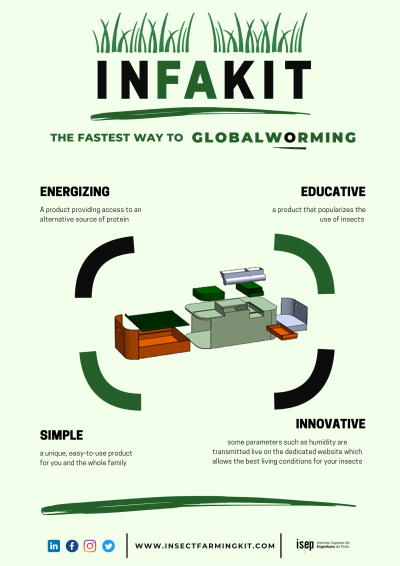
4.5.2 Targeting
The goal here is to define the typical profile of a user of the INFAKIT. At the end, the result would be used to enhance our communication regarding our product. To do that we used all the marketing tools seen before. It gave us the different segmentations here:
Geographic segmentation:
It is for someone coming from City. Especialy a big one because we want to reach the maximum of people We fought about big one because, in a general way, people are led to be more stimulated than in the countryside and therefore to be more open minded. We are looking to start our product in one Country and especially in a Western countries. Because in EAST people are more used to eat insect and at a lower price. This market already exist.

Demographic segmentation:
Young people, involved in new tech. someone who is starting out in life with 1 young child and still have time to manage his free time. We don’t have a specific gender, race or religion for our product but we are aware that some religious beliefs such as the Hanafite prohibit the consumption of insect. At this level, we prefer to leave people to their own interpretation but in the majority of religious beliefs, the consumption of insect is not prohibited.

Psychographic segmentation:
Regarding this segmentation, we are looking for Someone interested in new technology. Someone that is curious, dynamic and environmentaly involved. In the general way someone who is motivated to do things at 100 %. This is important for us because our product requires the involvement of the consumer. For example, when it comes to sorting out the mealworms in their larval phase or in their crysalid phase. Our target will also be someone looking for a new way to have protein add in his alimentation and able to consum insect.
4.5.2.1 Target Group
As the target group for our project, we decided to focus on urban residents. Having a garden or a balcony is no necessity. The target audience we want to address is people who follow an ecologically conscious lifestyle and want to explore new, sustainable ways of food production. They often do gardening by themself and have a lot of plants at home both indoor and outdoor. These people try to buy local goods. Creating as less waste as possible is a great necessity and they use biological food and care products. Because insects aren't that common in our daily life, we must appeal an open-minded audience who are prepared to experiment with an unusual way of dining and farming. They have to want to put the right amount of energy in the process of farming the insects and make a valuable output product from it. Our focus is to farm insects in a closed cycle, that means that at some point the insects have to die. For that reason, it is also important to reach people who are aware of the whole process and who are unlikely to get too emotionally attached with the insects.
4.5.3 Positioning
4.5.3.1 Elevator Pitch
For the nature-conscious, technology-interested home gardener for whom a natural compost is not exciting and efficient enough, the INFAKIT is an intelligent home insect farming kit that not only recycles your own food scraps into fertile soil but, unlike small scale home insect farms available on the market, also offers the possibility to process the used insects into edible protein powder for humans. Our solution is based on the latest technology, the most modern monitoring systems and a zero waste approach that allows all products (excuvae, frass) generated in the cycle to be completely converted into usable goods.
4.5.4 Brand
For our product we choose the name “INFAKIT”. This name came from the idea of our product. As a team, we decided to create an INsect FArming KIT. Is name was shorter, more impactful and easier to pronounces and remember.
Regarding the design of our logo, we wanted to keep it simple. We chose the colors green and black to remind the environment but also to make our logo captivate the eye. We added another reminder to the environment with grass overhanging our logo and reminding the importance we give to it within our company.

Moreover, the brand name INFAKIT and the website INFAKIT.com are available.
4.6 Adapted Marketing-Mix
The 4Ps, shown in Figure 25 framework allows the entrepreneur to think globally and not neglect any point of his commercial strategy. The 4Ps are a method used for reviewing the different marketing levers available to the company. When mixed with the right mix, the 4Ps should enable the company to find the ideal recipe for marketing its products and services.
The 4P formula (also known as the Marketing Mix) combines the following 4 policies:

4.6.0.1 Product
As far as INFAKIT is concerned, our objective was to create a tool for the production of food proteins and fertilizers. Its design is simple as well as its use. The idea is to use the entire life cycle of the mealworm so that nothing is lost. We wanted a complete use of the available resources. From the waste of the mealworm for the production of fertilizer to the use of our packaging to create optimal living conditions for our mealworms.
4.6.0.2 Price
We don't know what would be the final price at the moment. Regarding our material cost on part 7.6, our prototype is 64,29 €. Our goal is to provide a product that won't be too expansive. The consumers we target remain financially independent and we believe that a price of 85 € would be optimal. However, it is important to qualify this statement. This price corresponds to the market in which we have realized a single prototype. That is to say, a unique product from materials coming from a specific market. If we want to be more rigorous, we should specify that this price can vary according to the country in which the product will be distributed. If we base ourselves on the time of today in countries of the East, the general cost of the materials is less expensive because the cost of the lin general is less high. Moreover, the cost of our product can be reduced if we decide to buy raw materials in bulk or install production lines. So this price of 85 euros is subjective and only based on a high estimate of the production cost.
4.6.0.3 Place
The main goal was to decide what would be the best place to sell our product. Owning a store is an expansive thing to do even though there are many benefits to be listed. However, TeamOnesect only counts INFAKIT in its sales products for the moment. That's why selling through the internet seems to us to be the best way to share our knowledge with our customers. To do this we will create a special section on our website to sell our product. From this section, it will be possible to see the characteristics of the product and the opinions of former customers to reassure our future customers. And to continue in this way, we emphasize an after-sales service that must be efficient.
4.6.0.4 Promotion
We aim to enter the market in early 2024. For this, we will have to communicate before this date but also after it. Social networks are today a very powerful tool in terms of exchange and access to information. That's why we intend to base a large majority of our communication strategy on this media. Our targeted networks are Instagram and Facebook because they correspond to the optimal age range of our target consumer. This is all the more coherent as our point of sale will be dematerialized which will simplify the navigation of the consumer, from the site where the ad will take place to our sales site.
4.7 Budget
A marketing budget is an instrument to help to achieve our business goals. That why is it important to have a strategy correclty defined. It include objectives for the coming months and years. It is composed of the costs and investment used to promote our product or company.
The main purpose of creating and spending marketing budgets can be :
- informate the consumer about the product
- increase the popularity of the brand
- improve the brand image
- Counter brand's councurren
- attract investor or business partners
| Incomes | Price (€) |
|---|---|
| Sponsors and investors | 15 000€ |
| Capital for each member of the team (500€x5) | 2 500€ |
| Total | 17 500€ |
| Expenses | |
| Leaflet | 96,50€ |
| Poster | 44,76€ |
| Official websitepage | 2 000€ |
| Hosting | 100€/year |
| Instagram advertising | 700€/month |
| Facebook advertising | 700€/month |
| Total | 3 641,26€ |
| invesment per month | 1 408,3€ |
| invesment per year | 16 900€ |
For the estimation of the prices, we based ourselves on professionals based in Portugal when it was possible. For example with the company 360imprimir for the leaflets and vistaprint for the posters. We also did our research to estimate the price of digital promotions like Facebook and Instagram. These are the two networks that are closest to our target age group, that's why we focus on these two while discarding Snapchat and others less relevant.
4.8 Strategy Control
In order to define a solid action plan with defined objectives, it is necessary to be able to manage the current situation but also to prepare for the future of the company. For this, it is necessary to be prepared. In order to be ready for as many current and future scenarios as possible, we can turn to the PDCA, which is also shown in Figure 26,cycle for Plan-Do-Check-Act. The PDCA cycle is a method of continuous improvement, it avoids a linear representation and the different processes are managed in a circular way in order to allow the most optimized control possible.
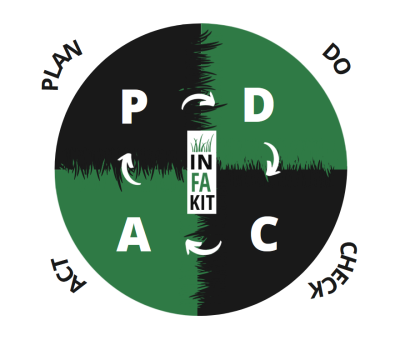
4.8.0.1 PDCA Strategy
The 4 steps of the PDCA process are in its name: Plan, Do, Check and Act. This process is a cycle, which means that once you reach the end, you can start again from the beginning.
Plan : For any process improvement or project planning, the first step is to define the work to be done. Like any project plan, this includes a variety of information. Here we will talk about the project objectives, the indicators of success, the project timeline and its participants.
Do : Once the project plan is established, the next step is to put it to the test. Like most types of lean project management, the PDCA cycle emphasizes small, incremental changes. During the execution phase of the cycle, implement the project plan on a small scale to ensure that it works.
Check: The tests performed during the implementation phase of the PDCA cycle are analyzed to ensure that everything went as planned. This often reveals things that need to be improved during the implementation phase! The monitoring phase is crucial to find these little things before they become too big and problematic. It is during this phase that we can revisit the project plan if necessary to ensure that the project is still meeting its objectives. If not, this is where we can change them
Act: After the “check” phase comes the “Act” phase, which includes the full deployment of the project or process improvement. After that it is still possible to go back to the pan phase to keep improving our project.
Following this pattern is a significant security to the different market developments, trends and consumer mindset. We can give examples of controls that can be done from our digital point of sale. For example, reaching 5k followers the first year and 10K followers the second on instagram. Count at least 100 visits on the sales area of the site per week. Or to have sold 100 products the first week after the opening of the sales space.
4.9 Conclusion
The consumption of insects is growing in Europe. The European market for insect use in general is young but promising. INFAKIT is a tool that fits into this dynamic. The objective is to promote a product that allows you to create your own protein source at home. In the long term, it would also help the growing populations in Europe to feed themselves by developing this young market. Our different analyses such as the SWOT analysis showed that our market was still young and that we had to constantly deal with it and the competition. One of our strengths is the fact that we are a young, dynamic company, able to face the market evolutions. Our target market are young people developing in the active life and wishing to work for the planet. The marketing mix Product, Price, Promotion and Place (4P) allows us to adapt the marketing strategy to the target market. In this regard, INFAKIT, through a communication campaign and the website will provide information about its activities to reassure consumers. The price of our product should vary depending on the country of production. This plays for example on the cost of services, raw materials. According to our estimates, it could vary from 35 to 90 euros, and will contribute to develop the image of insects in the communities. It is however important to specify that the well being of our insects is also one of our priorities. This aspect is a major part of our project and we will address it in the next chapter.
5. Eco-efficiency Measures for Sustainability
5.1 Introduction
The most recent report of the Intergovernmental Panel on Climate Change, IPCC, shows that working on environmental and sustainable solutions for world problems become increasingly important. We are in a global climate crisis: while resources are becoming scarcer and scarcer, global temperatures are rising steadily, for example, the UK has even raised the threshold above which it is called a heat wave this year [IPCC, 2022] [Met Office, 2022].
The goal of the Brundtland Report from 1987 was to develop guidelines for the United Nations to achieve sustainable development by the year 2000 and beyond, defining sustainable development as the “development that meets the needs of the present without compromising the ability of future generations to meet their own needs” [Gro Harlem Brundtland, 1987].
They further present three pillars on which sustainable development builds up and which each should be taken into further consideration. The following chapter summaries how the Company TeamOnesect and its main product the INFAKIT approaches and includes environmental, social and ecological concerns.
5.2 Environmental
A major driver of global greenhouse gas emissions and usage of land is the worldwide livestock production, with 14 %, which is forecast to increase even further in the coming years as global demand for meat also increases [50]. Mealworms could serve as a more environmentally friendly alternative: producing the same amount of protein, for example, requires only about 10% of land compared to protein production from cattle [51].
Furthermore, the used insects require much less water to survive and are way more drought-resistant, which offers a more resource-efficient alternative in the face of ever-decreasing water resources and prolonged droughts [52].
The INFAKIT is a small-scale home farming kit, which aims to introduce people to a protein-rich diet of insects at home and thus stimulate a global rethink on a small scale, which in the long run will trigger a revolution in the food industry.
Moreover, ecological concerns played a major role in the design and packaging of our product. While the latter is going to be completely out of recycled cardboard, the INFAKIT itself relies on modern sensor technology that efficiently controls the use of fans to ensure the ideal environmental conditions for the insects.
In the selection of the electronic components, special attention was paid to efficient and resource-saving (electricity), as well as long-lasting criteria. The possibility to monitor the INFAKIT via app, enables the user to control it even from afar, making the home farming kit even more long-lasting, since suddenly occurring changes in the breeding system easily can be managed even if the user is on vacation for example.
5.3 Economical
An economically sustainable company is committed to compliance with legal requirements and fair staffing of key positions. While profit is desirable and important to ensure economic sustainability, care is taken not to do so at the expense of human, natural or other resources [Andrew Beattie, 2021].
This company approaches its economical sustainability through a proper risk management, assessing problems and uncertainties to prevent or to find solutions in a timely manner. Further, through forecasting and reevaluating the company is able to adapt to change.
Moreover, needed components for the INFAKIT are procured regionally, which supports the local economy. The eco-efficient approach of the INFAKIT which focuses on using as few resources as possible, also has the positive side effect of saving financial resources that can be invested in other areas, like higher quality products or human resources.
5.4 Social
United Nations Global Compact defines Social Sustainability as “identifying and managing business impacts both, positive and negative, on people.” They further state that “directly or indirectly, companies affect what happens to employees, workers in the value chain, customers and local communities, and it is important to manage impacts proactively” [United Nations Global Compact, 2020].
The INFAKIT offers households a new way to connect and explore together alternative ways to recycle waste. It teaches kids to take over responsibility over living animals and educates them about global issues and ways to rethink about them. Moreover, the home farming kit invites its users to overthink their eating habits, hopes to start a discussion and further leading to more openness about alternative food production. Global problems need global solutions – and the willingness of the population to be open for change.
Our company wants to invite people to participate in a larger community: connecting people from all over the world via social network platforms like Instagram to share recipes, best practices, and experiences. Communication is a key value of our company, and we are very keen on being in direct contact with our customers in order to take care of all of their concerns. We know as a company that to become the best version of ourselves and our products we have to be open for change and be flexible enough to adapt for better alternatives – and we are happy to grow with the feedback and input of our customers.
5.5 Life Cycle Analysis
To do the life-cycle analysis (LCA) properly, it first should be defined what an LCA is. According to the U.S. Environmental Protection Agency, “[…] LCA is a tool to evaluate the potential environmental impacts of a product […]. Crucially, an LCA is a comprehensive method for assessing all direct and indirect environmental impacts across the full life cycle of a product system, from materials acquisition, to manufacturing, to use, and to final disposition (disposal or reuse).” [55]
The whole life cycle can be divided into six different stages, starting with the used resources, and ending with the recycling. The graphical idea of this structure can be found in the following Figure 27:

In the following, we are going to analyze our product according to the six different stages of the LCA, beginning with our chosen resources and talk about the measures we took or will take in each sector in order to lower our carbon footprint, waste or greenhouse gas emissions.
Resources
As we want to make sure our product is as sustainable as possible, we need to take our chosen resources into account very precisely. These resources should be already recycled or recyclable, organic, and not toxic or harmful in any other way to humans and animals. Therefore, we decided to produce or order the required boxes made out of bioplastic. Advantages of bioplastic are reduced use of fossil fuel resources, a smaller carbon footprint, and faster decomposition. Bioplastic is also less toxic and does not contain bisphenol A, a hormone disrupter that is often found in traditional plastics. Also for our electronic components, there are many ways to keep them as sustainable as possible, for example by using biodegradable circuit boards or environmentally friendly cables. For the used sieves aluminum is a good choice to go with, it is easy to mine and handle and has a high recycling rate and only little environmental impact.
Manufacturing/Distribution
As our idea and company are still in an early phase of development there are not many ways to keep environmental impact low in a matter of manufacturing and distribution. By using renewable energies, such as solar, wind, thermal, or tidal energy, to power our production site a positive impact can be made. One thing which can be done is to keep the production close to the final market. By doing that we can keep our distribution distances as short as possible. Furthermore, ordering our materials and resources from local retailers can help avoid unnecessary greenhouse gas emissions. Also selling our products not only online but also in shops and at events like trade fairs can help to prevent needless distributions. In addition, our production and distribution could be organized in a Lean approach. Lean is a way of organizing a company and its production and logistics is the most effective and efficient way, by continuous improvement, using standards, and open to critic corporate culture. Striving for efficiency and effectiveness may not only help the company to make more turnover but also lower greenhouse gas emissions and resource use just as avoiding pollution.
Packaging
For our packaging solution, we came up with the idea of reusable cupboard packaging. The cupboard itself is already an easy to recycle material and as we are sticking to the DIN EN 13432 norm, we commit ourselves to only using biodegradable materials for our packaging solution. Anyway, if the customer uses our packaging accordingly to the purpose we designed it for, besides transporting and keeping the INFAKIT, there will be no need to trough it away. Our idea is to have the cupboard also as a “privacy screen” on the one hand to “hide it” if for example guests are coming to your house and you know they are not comfortable with insects and on the other hand to dim the light for the mealworms on hot and sunny days as they prefer darkness or at least twilight. Therefore, we will print our cupboard/packaging with some colors to make it nicer to look at and fit better in your interior. The inks we use are all inks of biological origin, based on vegetable oils or resins and water-soluble, with a high proportion of raw materials based on renewable resources.
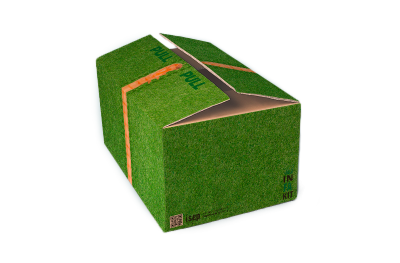
Use
The use of the INFAKIT can be considered as having more of a positive impact than a negative impact on the environment. The electricity used for the INFAKIT is compared to other housing gadgets rather low and the mealworm-life cycle makes it redundant to buy new mealworms every couple of times and provides an “endlessly” supply of high-protein animal and human food and fertilizer for house or garden plants. Not only that but also the attitude towards bugs and other insects in general but also as food, just as the whole nature with its perfectly working life cycles can be changed in a positive way.
Recycling
The modular design of the INFAKIT makes it quite easy to recycle its parts as the components can be disposed separately very easily. But also, that way of designing makes it almost needless to throw your INFAKIT away at all. High-quality plastics and aluminum sieves can be used over a lifetime and the electronical components found in the INFAKIT and designed also modularly can be rebought and exchanged easily. If someone decides to say goodbye to their INFAKIT anyway, they can just break the lifecycle by not letting any mealworms turn into pupae. After that, the last batch of mealworms can be farmed, and the different components can be cleaned (only non-electronical) and disposed separately and correctly.
5.6 Conclusion
In this chapter we focused on the sustainable aspects of our product and company, what we need to keep in mind and what we could still do better respectively what are the next measures we should come up with.
Therefore, we first defined sustainability and explained the three pillars sustainable development is based on:
- Environmental sustainability
- Social sustainability
- Economical sustainability
For each pillar, we explained what our positive aspects regarding this topic will be and what problems we wanted to tackle. Especially for environmental sustainability, our product could make an actual impact as mealworms as a protein source are a lot more environmentally friendly than cattle. Furthermore, more regarding the social aspect, we want to raise awareness of the environmental life cycle and help change people’s minds when it comes to insects as food.
Also, as an outcome of our life-cycle analysis, we decided for example to produce close to our potential consumer market to keep delivery distances short or only use certified colors for printing our packaging.
In the upcoming chapter we are going to take a closer look at ethical and deontological concerns regarding the INFAKIT, for example, are we going to discuss the killing and processing of the mealworms.
6. Ethical and Deontological Concerns
6.1 Introduction
Deontology is a term used to describe a philosophy that proposes whether acts are good or bad based on a set of principles. Actions that follow these criteria are considered ethical. As a result, ethical and deontological considerations are extremely important and have a significant impact on today's society. To prosper and maintain a favorable image, businesses must address each of these problems. If the contrary occurs in the modern period, it is very likely that social media would hasten the spreading of news, causing it to reach the entire world very quickly and having a negative influence on the organization. Engineering, sales and marketing, environmental, and liability are the four key ethical and deontological problems raised by the project in this chapter. For the project to thrive and have a beneficial influence on society, it is critical to analyze these problems, and each concern must be addressed [The Ethics Centre, 2016].
6.2 Engineering Ethics
Engineering is an important and well-studied field. Engineers are required to uphold the highest levels of honesty and integrity as members of their profession. Engineering has a direct and significant influence on everyone's quality of life. As a result, engineers' services must be based on honesty, impartiality, fairness, and equity, as well as a commitment to the public's health, safety, and welfare. Engineers must adhere to a professional code of conduct that compels them to follow the highest ethical standards.
I. According to the National Society of Professional Engineers, the fundamental canons in fulfilling the professional duties of an engineer shall be: [National Society of Professional Engineers, 2019]
1. Hold paramount the safety, health, and welfare of the public.
2. Perform services only in areas of their competence.
3. Issue public statements only in an objective and truthful manner.
4. Act for each employer or client as faithful agents or trustees.
5. Avoid deceptive acts.
6. Conduct themselves honorably, responsibly, ethically, and lawfully so as to enhance the honor, reputation, and usefulness of the profession.
II. Rules of practice
1. Engineers shall hold paramount the safety, health, and welfare of the public.
2. If engineers' judgment is overruled under circumstances that endanger life or property, they shall notify their employer or client and such other authority as may be appropriate.
3. Engineers shall approve only those engineering documents that are in conformity with applicable standards.
4. Engineers shall not reveal facts, data, or information without the prior consent of the client or employer except as authorized or required by law or this Code.
5. Engineers shall not permit the use of their name or associate in business ventures with any person or firm that they believe is engaged in fraudulent or dishonest enterprise.
6. Engineers shall not aid or abet the unlawful practice of engineering by a person or firm.
7. Engineers having knowledge of any alleged violation of this Code shall report thereon to appropriate professional bodies and, when relevant, also to public authorities, and cooperate with the proper authorities in furnishing such information or assistance as may be required.
8. Engineers shall issue public statements only in an objective and truthful manner.
9. Engineers shall be objective and truthful in professional reports, statements, or testimony. They shall include all relevant and pertinent information in such reports, statements, or testimony, which should bear the date indicating when it was current.
10. Engineers may express publicly technical opinions that are founded upon knowledge of the facts and competence in the subject matter.
11. Engineers shall issue no statements, criticisms, or arguments on technical matters that are inspired or paid for by interested parties, unless they have prefaced their comments by explicitly identifying the interested parties on whose behalf they are speaking, and by revealing the existence of any interest the engineers may have in the matters.
III. Professional Obligations
1. Engineers shall be guided in all their relations by the highest standards of honesty and integrity.
2. Engineers shall acknowledge their errors and shall not distort or alter the facts.
3. Engineers shall advise their clients or employers when they believe a project will not be successful.
4. Engineers shall treat all persons with dignity, respect, fairness and without discrimination.
5. Engineers shall at all times strive to serve the public interest.
6. Engineers are encouraged to participate in civic affairs; career guidance for youths; and work for the advancement of the safety, health, and well-being of their community.
7. Engineers are encouraged to extend public knowledge and appreciation of engineering and its achievements.
8. Engineers are encouraged to adhere to the principles of sustainable development1 in order to protect the environment for future generations.
9. Engineers shall avoid all conduct or practice that deceives the public.
10. Engineers shall avoid the use of statements containing a material misrepresentation of fact or omitting a material fact.
As a team, we agree to follow and respect the ethical aspect of our profession as engineers, always thinking about the higher good.
6.3 Sales and Marketing Ethics
Markets are characterized by a clash of interests among multiple stakeholders. There is rivalry for resources, consumers, and pricing, among other things, which creates fertile ground for actions that may not be ethical. To manage markets and marketing, a specific code of behavior, regulations, and procedures known as ethics are essential [Prachi Juneja, 2015].
Our company's sales ethics may propel it to new heights. We will pave the way for client loyalty, improved morale among our sales staff (because we know that we are selling something good, we are not hiding any aspect) and marketing team, and even sustainable growth by incorporating ethical culture into our company [Pipedrive, 2022].
But what is sell ethics? Sales ethics are a set of behaviors that ensure that every lead, prospect, and customer is handled with respect, fairness, honesty, and integrity. It implies that as a salesperson or marketer, you prioritize the individuals to whom you sell. Instead of imposing your agenda on people, you accept their choices and ideas. Considering the long term, ethical sales behaviour makes sense - we want to establish loyalty and trust with consumers by doing the right thing. The outcome ? Higher consumer spending, more engaged staff, and lower business operating expenses. By using an ethical approach to sales, we're stating clearly that we prefer to sell to clients who want to buy from us rather than selling by any means possible.
This strategy will aid in the development of a client base of users that we can serve and support, as well as the development of mutually beneficial connections. This implies that we will not only sell, but also build our business in an ethical and honest manner.
Good practices to follow: [Pipedrive, 2022]
1) Always be honest about the impact your product makes.
2) Don’t attack our competitors.
3) Adopt the „Serve Don’t Sell Method”, which is made of five stages:
a. Fit: define your Perfect Fit Client (PFC) using demographic and psychographic factors such as job title, industry, company size, beliefs, core problems, previous experience.
b. Discovery: establish your prospect’s personal and organizational pain points, why this change needs to happen now, their goals, objectives and motivations.
c. Offer: include your prospect’s pain points and goals, how you can help, examples of similar previous clients, options of working with you and a Q&A section.
d. Agreement: send a written proposal, collect and address unmet needs and get a signed contract.
e. Transition: onboard and prepare your client, establish points of contact and send supporting materials and documentation that will make them more successful.
6.4 Environmental Ethics
Environmental ethics is a field of ethics that studies the relationship between humans and the environment, as well as the role of ethics in this relationship [Rinkesh, 2020].
In order to provide a product that is environmentally friendly, our team will focus on these points:
1) Maximize the efficiency with minimal energy consumption. We are choosing the best ratio between the quality of the components and their energy consumption.
2) Using recycled or recyclable materials in our product.
3) Our product is focused on the „zero waste” set of principles.
Another aspect that we consider is the killing of the mealworms and whether this is ethical or not. Recent surveys of U.K. insect farmers found many are concerned about insect pain perception and providing their mini-livestock a “good death.” The most common slaughter methods large-scale insect farmers use are freezing or freeze-drying, with the assumption that the cold-blooded insects will fall asleep and never wake up [Matan Shelomi, 2021].
We consider that, by following these guidelines, we can this achieve harmony between humans, plants, and animals in our environment. Furthermore, the purpose of our research is to contribute to the solution of the food waste problem as well as to provide a simple solution for organic food production in metropolitan areas. This is an excellent technique to feed the world's rising population while adhering to natural principles and preserving the environment to the greatest extent possible.
6.5 Liability
Liability is defined as “the state of being legally responsible for something”. When creating and putting a product on the market, this is a major legal aspect by which the company is protected from lawsuits regarding accidents caused by their product / the usage of their product.
For the EPS project, the team must comply with the following EU Directives to avoid product liability issues:
1. Machine Directive (2006/42/CE 2006-05-17): concerning the danger machines may present to men, such as explosions, vibrations, radiation, finger joints, dangerous substances in flight, force limits for the operation of machines, minimum safety distance [European Commission, 2006].
2. Electromagnetic Compatibility (EMC) Directive (2004/108/EC 2004-12-15): intends to regulate side effects between electronic components that are connected / interface together, like electromagnetic radiation, fields in the vicinity of electronic components, etc [European Commission, 2004].
3. Low Voltage Directive (LVD) (2014/35/EU 2016-04-20): concerning health and safety challenges of electrical equipment with defined limits of voltage [European Commission, 2014].
4. Radio Equipment Directive (RED) (2014/53/EU 2014-04-16): a regulatory framework for placing radio equipment on the market, ensuring no interference and data security regulation in radio communication with other devices [European Commission, 2014].
5. Restriction of Hazardous Substances (ROHS) in Electrical and Electronic Equipment Directive (2002/95/EC 2003-01-27): prohibition of the use of certain substances, to protect the environment and public health [European Commission, 2003].
Additionally to these directives, the team needs to respect the rights of other established brands. The protection of a company's goods and services is ensured by making it a trademark. A trademark is a sign used to distinguish the goods or services of a firm in the market and it is protected by intellectual property rights. Apart from the trademark, other signs can be registered, such as logos, geographical indications, etc [Justica GOV, 2020].
The team consulted the European Union Intellectual Property Office (EUIPO) to assure INFAKIT is available, and no results were found.
6.6 Conclusion
Based on this ethical and deontological analysis, the team decided to focus on efficiency during the manufacturing process (we use the components with minimum consumption that satisfy our needs), use sustainable and recyclable materials, choose suppliers who are transparent about their products and their origins, and keep customers and coworkers in mind at all times during the product development process.
The team will always be honest and follow an environmentally responsible path to build a product that does not harm the environment, uses as little energy as possible, as well as a transparent and honest customer service, because this is the only way for us to grow as a company.
In the next chapter, we will be discussing the project development part with all its components.
7. Project Development
7.1 Introduction
The following chapter, “project development” describes the ongoing process of developing and carrying out our EPS project idea the INFAKIT. The chapter subdivides into 7 sections and starts with the ideation of our project idea, which includes the blackbox diagram, first structural drafts, and a cardboard model. Here we explain how our design idea developed and a rough design idea is presented. Furthermore, we talk about our concept of the product, starting with our logo and ending with possible regulations and requirements. In the fourth section, the specific project idea and design are stated by detailed drawings, the selection of materials is explained, and a stress simulation test is carried out. The last sections explain everything about the actual system and system design, what components we use and how are they connected, the realized prototype, and lastly real simulations and tests and a conclusion. At the end of the chapter, you will be able to follow the whole development process of our EPS project idea, from the ideation to the prototype and the testing.
7.2 Ideation
After agreeing on a basic project idea, a home farming kit for mealworms, we started brainstorming about how we wanted to design our INFAKIT, what components it should include and how these components are connected to another.
blackbox diagram, structural sketches and cardboard model
7.2.1 Blackbox
Our first draft of the blackbox diagram was rather rough but included all parts we wanted our INFAKIT to include, Figure 29.
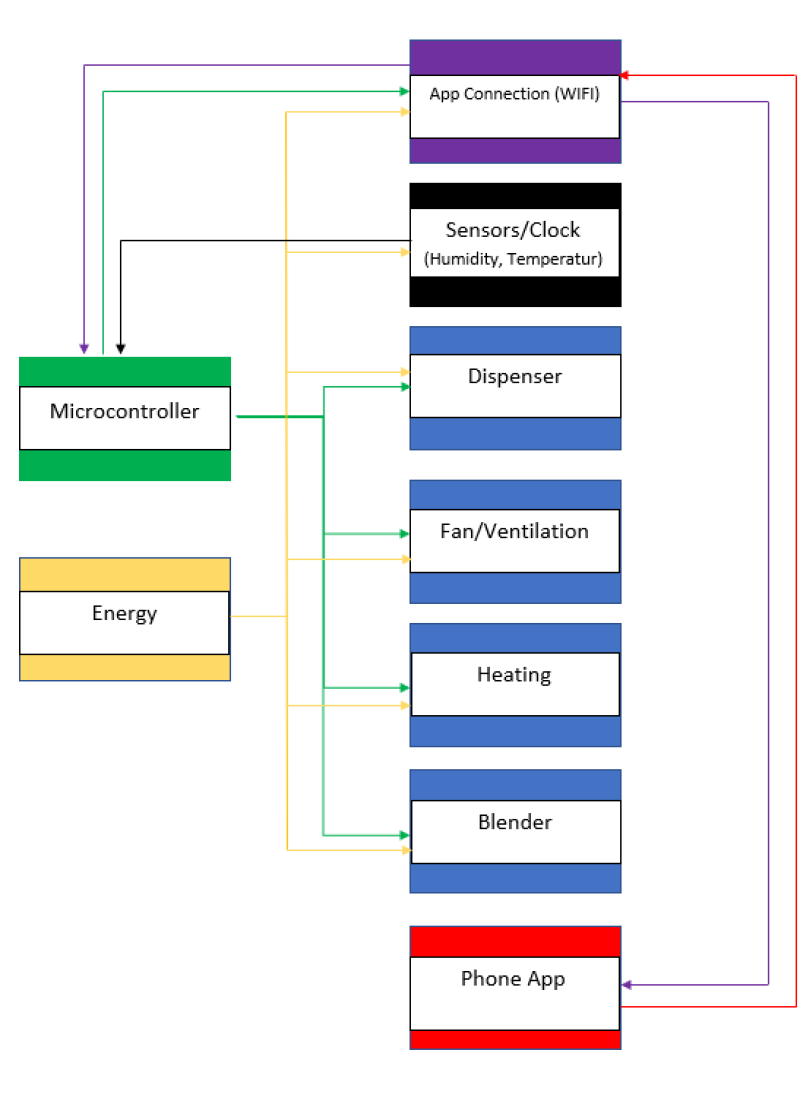
The whole setup is controlled by a microcontroller which provides information to the four actuators, heater, blender, fan, and dispenser. Sensors like humidity and temperature provide the microcontroller with information, which it receives, processes, and forward as commands to the actuators. In order to be able to control the INFAKIT by a phone app, we included a Wi-Fi connection in the setup. After some more research and discussions, we decided to abandon the heating, which would be used for drying the mealworm, and the blender, to crush the mealworms, as we thought these things are included in almost every household and can easily be done by the people themselves. Furthermore, we decided on an internet-capable microcontroller, so we could omit the Wi-Fi connection. In addition, our dispenser will be turned automatically by the included servo engine in order to provide food without being at home. After these decisions, we came up with the following blackbox setup, Figure 30.

7.2.2 Sketching and cardboard model
Ongoing with the technical blackbox diagram we developed our first sketches and design ideas of the INFAKIT, and what it may look like. The first sketch can be found in Figure 31.
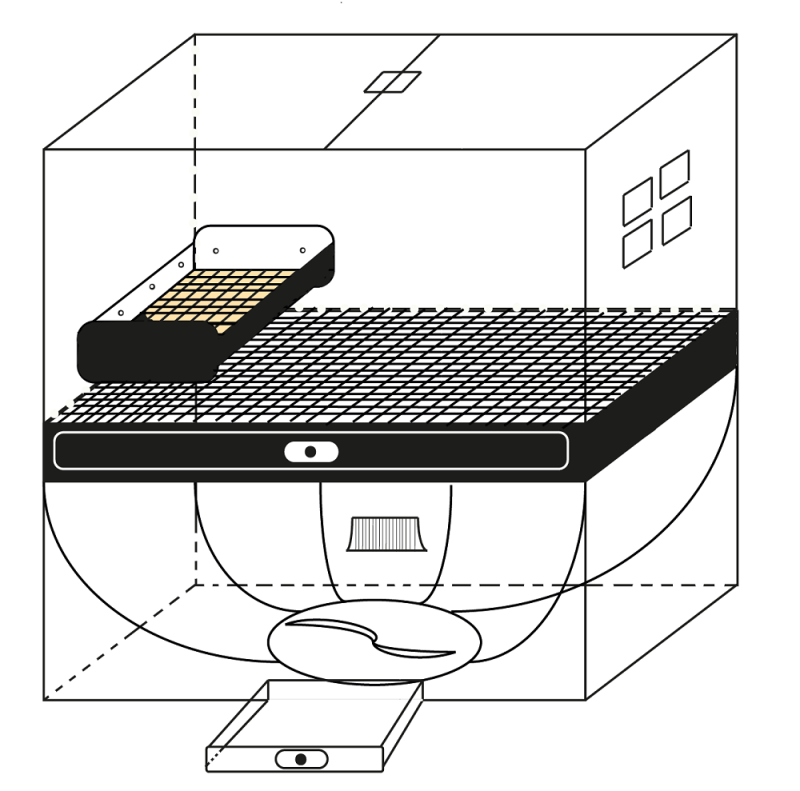
As you can see in Figure Figure 31, in our first draft the blender (lower level, middle) was still included in our design idea, furthermore, we wanted to keep the larvae, beetles, and eggs in one cage (highest level), which we changed in order to separate them more easily and prevent the beetles from eating the eggs. In addition, the design was not modular at all, which made it almost impossible to replace broken parts and components. It is clear some more refining of the concept is necessary. In the next chapter our final concept is explainend.
7.3 Concept
7.3.1 Logo
For the name of our product, we chose INFAKIT. The name comes from INsect FArming KIT. We think the strength of the name of our product lies in its simplicity. It is clear from where it comes, and it makes sure it sticks better in the minds of consumers.
For our logo we have chosen to place the three parts of the name below each other, as you can see in Figure 32. This also makes it clear that the name INFAKIT is an abbreviation. For the use of color, we chose only two colors. This ties in with the simplicity of the design and the name. The colors are black and dark green. The green gives the logo an ecological connotation and together with the grass on top it refers to the soil recovery. The dark green will also appear in our product so it is easy to connect the logo with the product. The logo is simple and is thus easy to recognize and remember.

7.3.2 Concept elaboration
After some more research, sketching and deciding to omit blender and heating, we designed our INFAKIT as shown in Figure 33 and Figure 34
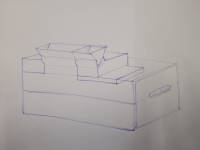
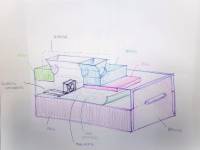
The idea is to work in layers and divide the pupae, the beetles and the mealworms in different compartments. We create a compartment in the back with all the electrical components. This allows for easy repair and maintenance. It also makes the design more modular. The fan is also located in this part. It blows in the direction of the sieve. The sieve has a slight slope on one side. This ensures that the frass can blow over the edge but not the mealworms. In this way we avoid the mealworms ending up in the frass drawer. The dispenser makes it possible to feed the beetles and the mealworms in once.
In Figure 35 you can see the first structural sketches of the setup. This shows where what will be in the final design. It gives an overview of the different components and compartments.
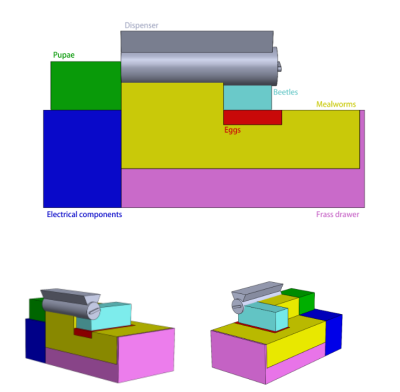
When the beetles lay their eggs, they immediately fall through a sieve and into the egg compartment. When the eggs hatch and are mealworms, they must be manually moved (with tweezers) to the sieve on top of the frass drawer. This is where the largest population eventually ends up and where the exuvia is also brought to the frass drawer through a sieve. Thus, by extending the frass drawer, both the mealworms and the fertilizer can be harvested. It is important not to harvest all the mealworms at once because then the cycle is at its end. There must also be some worms that go to the pupae stage to eventually create new beetles.
In short our new design contains:
- Three removable boxes for the three of the four different stages of the mealworm lifecycle (egg, mealworm, larvae, and beetle)
- One removable box, including all the electronics (microcontroller, fan, sensors, and servo engine) with easy access and the possibility to exchange broken parts
- One removable drawer holding the sieve where the mealworms live and storing the frass and exuviae on a lower level
- One food dispenser which is controlled by the microcontroller and moved by the servo engine
Now in the next stage, a final design and more detailed drawings need to be created.
7.4 Structural Design
selection of materials, detailed drawings, load and stress simulation tests
Materials selected will be eco-friendly, but durable. For example, some parts of the system can be made from recycled plastic.
For the design of our product in Figure 36, we are again, just like our logo, going for simplicity. We ensure that all components have a different shape so that there is only one possibility to put the design together correctly. This avoids confusion and increases the ease of use.
The different functions are indicated by colors to increase convenience. For example, all drawers that are used frequently are indicated with a bright orange color. Those who have animals are indicated by a dark green color. The electric drawer and dispenser are given a neutral color. This is because they need to be used/disconnected less. Neutral colors block unnecessary user interactions.
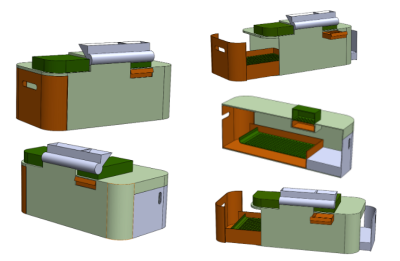
7.5 System Design
This chapter focuses on the components and technical setup of our endproduct, the INFAKIT, which we want to develop and provide to our customers. The electronical parts will be also used in our prototype, the design and non-electronical setup differs and will be further explained in section 7.6.
The INFAKIT consists of the assambly of different boxes which seperates the different stages of the lifecycle from each other. The combination of a humidity sensor and a Fan assures on the one hand the perfect living conditions for the mealworms and on the other hand seperates the frass and excuvae from the animals. A ramp prevents the mealworms to get blown over the edge to the collector tray.
The measurement of the INFAKIT's base, which consists of the excuvae/frass drawer and on top the mealworm tray, will be 550x300x200 mm.
The following table gives an overview over needed components and will be updated over time!
| Component | Subcomponent | Description | Measurements |
|---|---|---|---|
| Mealworms | 25 g of medium adult mealworms to beginn a lifecycle | ||
| Removable Breeding Boxes | Beetle Box | recycled plastic, with small holes in the ground to enable eggs falling through into egg box | 190x100x45 mm |
| Breeding (eggs) Box | recycled plastic | 190x100x35 mm | |
| Mealworm Box | recycled plastic | 550x300x200 mm | |
| Pupae Box | recycled plastic | 140x150x45 mm | |
| Removable Electronic Box | recycled plastic, including all the electronics (microcontroller, fan, sensors, and engine) with easy access and the possibility to exchange broken parts | 150x300x200 mm | |
| Twezzers | - | to seperate the different states of the mealworm manually | 200 mm |
| Removable Drawer | Frass and Excuvae collector inside of Mealworm Box, recycled plastic | 400x300x70 mm | |
| Food Dispenser | is controlled by microcontroller and moved by the servo motor | 270x70x70 mm |
For the technical setup, we came up with the following needed electronical components (listet in the table below). Figure 36 below will show a schematic overview over how the components will be connected. This setup will be needed for the endproduct as well as for the prototype. The main idea is, that a humidity sensor will evaluate the living conditions inside the INFAKIT and triggers the fan to start should it get to moist or hot inside. The second main assignment the fan has, is to blow the frass and excuvae over a little ramp into the collector tray, which can be easily removed by our customers to further process it to fertilizer.
| Component | Description | U Rated/Input/Supply Voltage | U Operating Voltage | I Current | P Power | Pmax (calculated) | Measurements | Price | Link |
|---|---|---|---|---|---|---|---|---|---|
| DC Power Jack Adapter Female | DC supply plug (male) / 5.5 mm / 2.1 mm / screw terminal / 12 mm | 1.00 € | [BotnRoll, 2022] | ||||||
| 12 V Male DC Power Socket Jack Plug Wire Connector Cable | DC 5.5x 2.1 mm. Wire Specification: 0.15 mm² Length: Approx. 27 cm Max Current Rating: 2 A Max Power Rating: 60 W Transmission voltage: 1 V ~ 38 V Usage temperature: - 50 ℃ ~ 65 ℃ Material: Copper Wire Use for: Led Driver/ Strip connector/ CCTV Camera.Price for 10 cables = 8.57 € | 1.00 € | [Banggood, 2022] | ||||||
| Power Supply Unit connected to Socket | 12 V AC/DC | 100-240 V 50/60 Hz | Output: 12 V | 5 A | 0.00 € | provided through supervisors | |||
| Fan | Sunon ME70151V1-000U-A99 | 12 V DC | 4.5-13.8 V | 0.113 A | 1.36 W | 1.56 W | 70x70x15 mm | 9.37 € | [MAUSER, 2022] |
| Micro Servo Motor | No load speed: 0.12 s / 60 degrees (4.8 V) Stall torque: 1.6 kg/ cm (4.8 V) | 4.8-6 V | <0.5 A | 3 W | 22.5 x 12.5 x 29.5 mm | 3.05 € | [MAUSER, 2022] | ||
| Transistor | BS170 MOSFET Pinout | 3.3 V | 0.5 A | 0.44 € | [MAUSER, 2022] | ||||
| Wemos D1 R32 C/ESP32 | ESP32-WROOM-32 in Arduino UNO form factor Working Voltage: 3.3 V DC Input Voltage: 5-12 V DC Wi-Fi: 802.11 b/g/n/e/i (802.11n up to 150 Mbps) Bluetooth: v4.2 BR/EDR and BLE specification RAM: 520KB Flash Memory: 32Mb (4M bytes) Power consumption: Max current: 250mA Sleep current: 0.15mA Active without WiFi current: 20 mA Operating Temperature: -40 °C > +85 °C | 5 V -12 V | 3.3 V logic | max current: 0.250 A; sleep current: 0.015 A; active without WiFi current: 0.200 A | 0.83 W | 68.5 x 53.7 mm | 8.90 € | [BotnRoll, 2022] | |
| T&H Sensor: | measures 0-80% humidity, 3% error, temperatures from -10 to 80 celsius with 0.4 degrees error | 1.9-3.6 V | 1.9-3.6 V | 0.150 A | 0.54 W | 15×15 mm | 08.11 € | [ElectroFun, 2022] | |
| Resistance | 10 kOhm | 0.55 € | [BotnRoll, 2022] |
- Total cost of electronical components: 32.42 €
- Total (worst case, max) power consumption whole system: 5.94 W
- max current: 0.5 A
- U = P/I –> U = 11.88 V
Links (will edited to references later):
- 12 V Male DC Power Socket Jack Plug Wire Connector Cable: [Banggood, 2022]
The following visualizations show the breadboard setup and circuit diagram in Figure 38, which we will use to run our system. Red wires show the connections to the voltage sources, while the black ones symbolise the ones to the ground. Yellow was used to show the connection to pins.

A transistor is needed to be able to use a 12 V fan, which we need for cooling down the INFAKIT and further to seperate frass & excuvae from the mealworms.
- It's Gate G is connected to an arduino pin and also to the ground with a 10k Ohm resistor inbetween.
- The Source S connects the transistor to the ground and
- the Drain D will be attached to the cathode of the fan.

7.6 Prototype
Prototype Design on Paper
The first plan and design to create our prototype is described below and shown in Figure 39:
- Top drawer - beetle & egg tower:
The first drawer is going to be cut the most drastically (approx. half of the full length). Inside we will add two more small boxes on top of each other. We will cut small holes in the floor of the upper box which allows only the eggs laid by the beetles to go through. So on top, we'll find the beetles, and below the eggs which will hatch into small baby mealworms. The tweezer will be needed to put the mealworms as soon as big enough in the second drawer.
- Middle drawer - mealworm layer:
The middle drawer will be cut, but so that its still bigger or longer than the top drawer - this is important to make sure, that when the dispenser model is added, both mealworms and beetles have access to food. At the end of the drawer, a plastic bar is glued to the base. This bar assures that the mealworms can't get past it, and only the exuviae and frass get blown over it. At the back of the drawer will be another box glued, which contains all the electronical components. We will cut a hole in both boxes which will be 'closed' by the fan.
- Ground Drawer - exuviae & frass collector:
The lowest drawer does not need any changes, since its only purpose is to collect the frass and exuviae which is blown over the little plastic bar in the middle drawer.

Actual Prototype
After receiving the actual components and starting building the actual prototype, we decided to change and adapt the plan (as it happens so often when you are actually working hands-on on something). The main component is still an organizer, but we modified it as follows.
- Top drawer - beetle & egg tower:
The top drawer only got cut on one corner in the back floor of the drawer - enabling food to fall through to the underlying mealworm layer. The bettles live in a plastic box, which ground is a sieve with small enough holes for only the eggs to fall through into another small plastic box. This tower is placed halfway under the hole in the lid to receive parts of the food, spend by the dispenser. The drawer can be pulled out completely, which makes cleaning and collecting the eggs easy.
- Middle drawer - mealworm layer:
The middle drawer's ground got almost completely removed and replaced through a sieve. In the end, we placed a plastic ramp followed by another hole in the ground - through which the exuviae can fall into the collector drawer. At the back wall, another hole is cut like in the planned prototype above to add the fan and sensor.
We placed the whole modified organizer on a lid, and placed the electronical components next to it - this makes an easy adjustment and switching of components possible. In the following figure (Figure 40) the backside as well as the beelte/egg tower gets displayed.

Components and Materials
The following table gives an overview of the needed components for the prototype. The electronical components remain the same as mentioned above for the end product, thus not further listed.
| Component | Measurement | Shop | Price | Picture |
|---|---|---|---|---|
| Organizer | 255x255x350 mm | Homa | 14.99 €*1 |  |
| Tweezers | 200 mm | Zoomalia.pt | 6.89 € |  |
| Beetle Box | 100x140x15 mm | plastic box found at home | 0 € |  |
| Egg Box | 100x140x15 mm | plastic box found at home | 0 € |  |
| Bar/Edge | MDF finishing profile WHITE 15X15X2600 mm | Leroy Merlin | 9.99 €*2 |  |
Total Costs: 64.29 €
- Total price non-electrical components prototype: 31.87 €*
- Total price electrical components: 32.42 €
Note*1: We found a similar organizer on OLX for 5 €, but it's near Lisbon. We contacted the owner - if shipping costs are cheaper than the alternative option, we will order the OLX version. This would make our prototype even more sustainable since we use resources that are already on the market and won't need to buy something completely new. OLX is a second-hand website for private people to sell their stuff online.
Note*2: the price is for the full length of 260 cm - we are sure that if we go to the local store, we can get only the 25 cm max we need for a cheaper price. Since the real price is unknown though we will calculate the price for the full length.
List of tools needed to develop prototype:
- Plastic Glue
- Saw able to cut plastic
- Sandpaper
List of References
- Organizer [Hôma, 2022]
- Organizer OLX [Olx, 2022]
- Tweezers [ZooMalia, 2022]
- Bar / Edge [LeroyMerlin, 2022]
Coding
In the following, we are going to show you the whole or most important aspects of the code for their actual functionality. This is on the one hand the usage of the prototype itself and all coding connected to this, like the fan (Figure 41),the servo (Figure 42), the Wi-Fi (Figure 43) and the sensors (Figure 44) and on the other hand the coding needed for the INFAKIT-Website (Figure 45):
INFAKIT:


Website:

Below in Figure 46, you can see the result of the designed website so far. On this website, you are able to check humidity and temperature, move the servo in order to open the dispenser, and start the fan to allow airflow and the collection of the exuviae:

7.7 Tests and Results
Prototype Design
To test and refine our initial idea we build an actual prototype - which as described in the chapter above, is slightly different than the original plan. This can be considered as testing while developing since we saw, while the actual building process, that for example cutting holes at the backside of the organizer makes more sense than cutting the drawers at the front. Reasons for that decision are on the one hand, that having a closed drawer (keeping the end wall) makes the whole prototype more compact and keeps the environment cleaner - since the exuviae do not get blown somewhere it shouldn't. Moreover, the connection from the dispenser to the microcontroller forces it to stay more to the back.
We can gladly say, that the separation of the different mealworm - lifecycle stages works fine with sieves and gravity. There is not enough time to see baby mealworms hatch from the eggs, but we trust that this will work. The good thing is, that the INFAKIT doesn't lose any eggs, even when minimizing the number of living beetles, since the beetle box can be easily separated from the underlying egg collector and put into the freezer. This also enables the cleaning of the beetle layer without affecting the living conditions of the eggs.
Usage of Fan
The usage of the fan was planned to be an innovative part, making it easy to separate frass and exuviae from the mealworms without intense sieving like other products. In general, this still works pretty well, but testing made it obvious that for the size of the drawer a stronger fan would make the process faster. What we didn't take into consideration, in the beginning, was, that the floor of the drawer is not a smooth plastic level but a sieve that allows air to escape, thus making the blowing power less strong.
Nevertheless, the fan is important for the cooling and regulation of the humidity in the INFAKIT.
Processing of Mealworms
To use the mealworms as a protein source further processing has to be done. We tested to find out which are the best conditions for the ideal processing and if the assumptions that we had worked out.
Regarding the killing of the mealworms, pupae, and beetles we found out that freezing for 48 hours in a normal kitchen freezer is sufficient to assure their slow and painless death. A longer freezing duration has no impact on the worms, thus making it the ideal place to stay until further processing.
In concern of preparing the worms for eating we can distinguish two approaches, which both work well: In the case of producing protein powder, it's best to put the worms into the oven for 25 to 30 mins at 100° C with two-sided heat, as shown in Figure 47. Higher temperatures lead to the burning of the worms, while a shorter duration let the worms stay soft and squishy in the middle, which we find on one hand not that appealing and tasty and on the other hand, is not ideal for further grinding it to powder.

For additional protein for a salad, for example, the worms can easily be prepared in a pan with just a bit of oil and spices, what we did and can be seen in Figure 48. The worms themselves don't taste like much and their scrunchy consistency reminds of chips.

7.8 Conclusion
To conclude, we found a way to make our idea of a mealworm home farming kit work. The final prototype differs from original and first ideas but like the main thesis of scrum - things develope throughout an iteratively process of testing and trying, evaluation and further adapting.
To make the seperation through the fan better possible, one or anotherone with more power or instead a shorter drawer would be recommended. Moreover, we suggest a clean and careful assembly since we observed that our inital assumption that the beetles and worms can't climb plastic turned out true, but they are smart enough to climb on the plastic clue passages over edges. (We quick-fixed that by applying tape over the concerned parts.)
The usage of homegrown mealworms as a protein source is a fun thing to do at home, and brings the user definetly closer to the insects. As a team we were initially more reserved to touch and feel the insects, but over the months working with them led us to actually eat them - with no contact issues at all anymore. A more detailed discussion will be provided in the next chapter.
8. Conclusions
8.1 Discussion
The discussion of our project needs to be separated into two pieces.
In the first part I would like to discuss the general idea, the main idea we developed at the beginning, and what we followed the whole time. We wanted to spread awareness about the sufficient life cycles and vulnerable ecosystems which are there in nature by helping people to start their own life cycles at home. Furthermore, and just as important to us, is our goal to make insect eating more common in today’s society and to help change people’s opinion about insects as a food source. If you consider these as our main goals, you could say we are on a good way to fulfilling that idea. The INFAKIT can provide you with proteins and mealworms to eat, closing the life cycle is easily possible and, speaking from our point of view, it is so much fun but also so interesting to see how nature works and the development from egg to beetle.
In the second part, we would like to discuss the way how our final design of the INFAKIT turned out and how it differs from our first idea. Our first draft of the INFAKIT contained a heater to dry the mealworms, a blender to process the dried mealworms, and a phone app to control the INFAKIT remotely. The final design of the INFAKIT doesn’t contain any of this. In our opinion, the blending unit and the heater could be left out as most people have an oven and a blender or grinder at home, furthermore, it would lower the production costs and of course the final price. In addition, we changed the phone application to a web application due to programming problems and time pressure. All in all, it can be said that we achieved to fulfill our main goal by providing the INFAKIT and encouraging people to look beyond the horizon. The INFAKIT itself turned out a little bit different and less automated than planned in the beginning, mostly due to practical reasons and to keep it affordable for a fair price.
8.2 Future Development
Now that we know our prototype works, the next step, of course, becomes developing the final product ready for sale. Techniques to make it on a large scale also need to be defined. Next, we want to focus more on starting a community for users of the INFAKIT. Also for people who do not own an INFAKIT, but have an interest in eating insects, there will be room within this community. We want to do this by expanding the website and making room for weekly blog posts and a section for recipes. Here, not only will the INFAKIT-experts have their say and share recipes, but everyday users can also use the platform to share their experiences. The website will also be expanded to allow for better remote management. The site can also be supplemented with an app to make it easier to use for mobile users.
The product can be upgraded by adding additional components. The electric drawer is modular in nature, so that modifications or improved components can be easily applied. If necessary, there is room for minor modification to make the design even more modular. This allows us to expand the design and grow larger populations. The option is there to expand the design both horizontally and vertically. Of course, this involves a lot of further elaboration.
In terms of marketing, we would also like to sell our product outside of Portugal and eventually beyond the European borders. Finally, we want to expand our business and possibly offer other insects. This still requires a lot of research and development. Also concerning the rules and legalization of other insects we still need research and improvement.
Our main goal is still to create a better world and make our diet more ecological by eating insects. We will therefore mainly focus on spreading awareness and acceptance of eating insects.
Bibliography
Will be added automatically by citing, in the body of the report, entries specified in BibTeX format and stored in the http://www.epswiki.dee.isep.ipp.pt/doku.php?id=refnotes:bib file
PS - If you have doubts on how to make citations, create captions, insert formulas, etc. visit this page with examples and select “Show pagesource” to see the source code.